
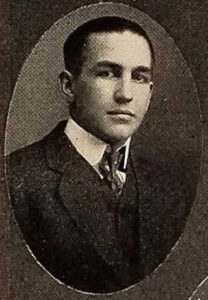
Deerfield, Michigan, December 13, 1895 – Rochford, Essex, England, April 25, 1918.1
Oxford and Grantham ✯ Training to Fly ✯ Fatal crash and afterwards
Elwood D. Stanbery was descended from a Josiah Stanborough who had emigrated from England to Lynn, Massachusetts, in about 1637 and who went on to be a founder of the town of Southampton on Long Island.2 One branch of the family settled in New Jersey. Around 1700 Elwood D. Stanbery’s great-grandfather, Samuel Stanbery, a veteran of the Revolutionary War, moved from New Jersey to Ohio. The latter’s son lived for a time in Michigan, but returned to Ohio, where Elwood D. Stanbery’s father, Byron Francis Stanbery was born. By the opening of the Civil War, Byron Francis Stanbery had moved to Michigan, and he served in a Michigan infantry unit during that war. In 1873 he married Mariah Diver, a descendant of Andrew Diver of New York, a Loyalist during the Revolutionary War; the latter’s son moved to Michigan where, several generations later, Mariah Diver was born.3 In passing I note that it is likely that Elwood D. Stanbery was given his mother’s family name as his middle name, but I have found no document to prove this. Byron and Mariah Stanbery settled in Deerfield, Michigan, where Byron Stanbery served as postmaster for many years.
Elwood D. Stanbery was the youngest child of the marriage by far; his brother Asa was born in 1874, and was followed by three girls and then twins, a boy and a girl, in 1888, and finally, in 1895, Elwood. (There may well have been other children who died in infancy, but I find no record of them.)
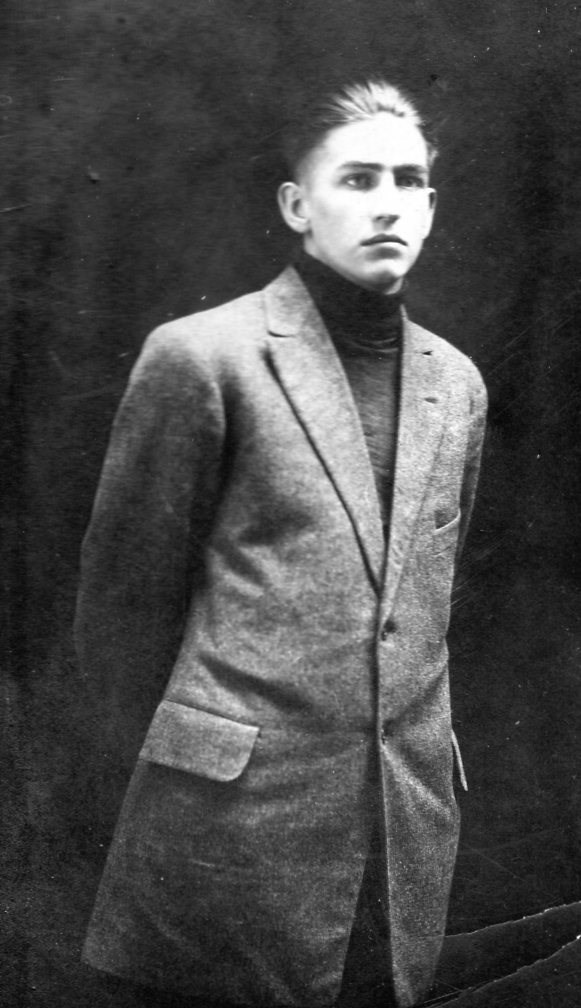
Stanbery attended school in Deerfield, Michigan, before transferring to the high school in nearby Dundee in the fall of 1912.4 He went on to study to be a teacher at Michigan State Normal College in Ypsilanti, where he distinguished himself as both an athlete and an orator.5 On completing his studies in 1915 he became a teacher at Highland Park, Michigan.6
When the U.S. entered the war, Stanbery sought to enter the aviation service, but was, according to posthumous accounts, initially discouraged by a lack of knowledge of internal combustion engines, which he remedied by getting a job at Cadillac Motor Company.7 He is said then to have failed his physical because of a slight limp caused by a childhood injury. However, with the backing of Gilbert Archibald Currie, whom he knew from having served as a page in the Michigan legislature, Stanbery was accepted by the Aviation Section of the Signal Corps and proceeded to the School of Military Aeronautics at the University of Illinois at Champaign.8 He graduated from ground school there with the class of August 25, 1917.9
One of Stanberry’s classmates was John McGavock Grider, whose diaries formed the basis of War Birds, the classic account of American aviators in the last years of the war. Stanbery is recalled briefly in the War Birds entry for April 20, 1918: “[Stanbery] and I were always good friends after our fight at Ground School. There was only one blow struck in that fight and he went out like a candle in the wind. We both apologized and have been good friends ever since.” This is probably Elliott White Springs’s version of a story recounted to him about an altercation between Grider and Stanbery at Champaign.
Government flight training facilities in the U.S. existed at this time mostly on paper, and offers from the Allies to train American pilots were welcomed. Around the time that Stanbery’s ground school class graduated there were openings in Foggia, Italy, and about one third of the men in this class, including Stanbery, chose or were chosen to go to Italy for flight training. They were thus among the 150 men of the “Italian detachment” who travelled to Europe on the Carmania. The ship departed New York on September 18, 1917, and, after a stopover at Halifax to meet up with a convoy, set out for the Atlantic crossing. In a letter written on October 5, 1917, Stanbery recalled that “The journey was long and comparatively uneventful. . . . I was quite seasick for a day but after that enjoyed the journey immensely.”10 The Carmania docked at Liverpool on October 2, 1917, and the expectation was that the men of the detachment would proceed on to “sunny Italy.”
Oxford and Grantham
However, as Stanbery wrote in the same letter:
I suppose you are somewhat surprised to see that I am writing from Oxford, England. Well, as a matter of fact, I am in somewhat the same state myself. Upon landing at [Liverpool], our detachment was informed the orders were changed and that we were to train in England. We were disappointed, of course, because we had set great hopes on going to Italy, and on the way across we had had Italian lessons twice a day and were well on the way to a good knowledge of the language. On the whole, however, I am not disappointed as I might be. Here we are among people who speak our own language, or rather we speak theirs; we are treated very finely, and already are great friends with the English cadets here with us.
The “Italian detachment” became the “second Oxford detachment,” a first detachment of Americans having arrived at Oxford about a month previously. The men were divided into two groups, and it appears that Stanbery was in the larger group of ninety men in the charge of Springs and housed at Christ Church College.11 Almost as soon as they had settled in: “Some of us are playing football, which is very strange to the English, even as their Rugby is strange to us.” Stanbery goes on to remark that “There is one part of the change [from Italy to England] where our detachment has the worst of it, and that is that we have to go through ground school again. It is a course of six weeks, and an exact duplicate of what we went through at Champaign.”12 The latter is not surprising, given that the U.S. had used the Royal Flying Corps as its model in designing its own ground school courses. Once their classes at Oxford began, various members of the detachment expressed their appreciation for the instruction because it was taught by men who, unlike the American instructors, had had actual flying experience at the front. Already familiar with the material, the cadets did not have to study particularly hard, and there are numerous accounts of socializing, athletic activities, and exploring Oxford and the surrounding countryside.
About half way through October, places for twenty men opened for flight training at Stamford, but Stanbery was not among the men selected to go there. The predicted six-week course at Oxford turned out to be only four. Nevertheless, disappointment was in store. Rather than proceeding at the beginning of November to training squadrons, Stanbery and the others still at Oxford were ordered to Harrowby Camp near Grantham in Lincolnshire to attend a machine gunnery school. As his fellow detachment member Parr Hooper, also ordered to Grantham, remarked, “It looks like we got sent here because there was no other place to send us to—playing for time.”13
During their first two weeks at Grantham, the men learned about and practiced using the Vickers machine gun. Once again, halfway through the month, there were openings for some of the detachment at training squadrons, but Stanbery was not among the fifty men selected. Instead, he and the remaining men proceeded to train for two weeks on the Lewis machine gun. They also began planning for a Thanksgiving celebration. This was carried off in great style, starting with a game of American football. The teams were called the Unfits and the Hardly Ables; Stanbery was fullback for the winning Unfits. A write up of the events of the day by detachment member Walter Chalaire describes how “Pop” Stanbery “with the aid of [John Marion] Goad . . . gained much ground for his team by working several successful forward passes.”14 The feast that followed the game included all the traditional dishes, including, according to Chalaire, “real apple pie a la mode.”
Training to Fly
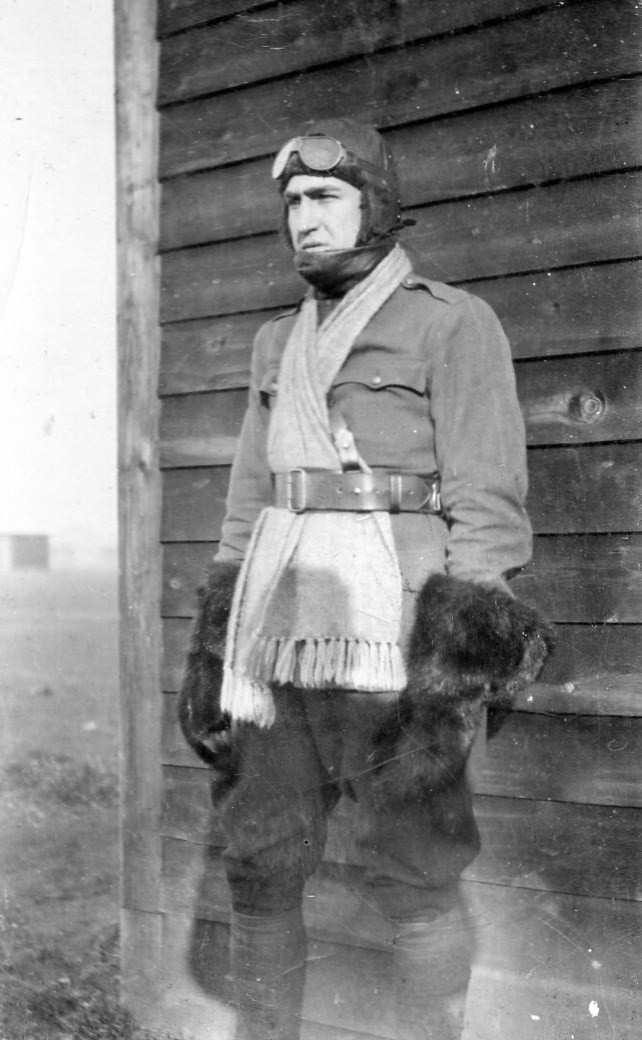
At the beginning of December, finally, the cadets still at Grantham were posted to training squadrons. Stanbery went with eleven others (Thomas Welch Blackburn, Jr., James Mitchell Coburn, Kenneth MacLean Cunningham, John Lavalle, Roy Edwin Martz, Leo McCarthy, Uel Thomas McCurry, Linn Daicy Merrill, Thomas Matthew Nial, Horace Palmer Wells, and Louis McComas Young) to No. 61 Squadron at Rochford in Essex.15 This was a home defense squadron flying S.E.5a’s, but Rochford had for some time also been used for training, and there were evidently training planes available.16 Some of the men are documented as having been almost immediately (re)assigned to No. 198 Night Training Squadron, which shared the airfield with No. 61 and which had Avros and Sopwith Pups for training purposes. Whether Stanbery was among those transferred to No. 198 is not documented, but it is noted on his R.A.F. service record that he flew both Avros and Pups.17
The twelve men evidently completed their elementary training sometime in January. According to McCurry, four of them were chosen for training on scouts.18 However, nearly all of them (including, to his disappointment, McCurry) went on either to Waddington or to Boscombe Down and trained to fly two-seater bombers and observation planes. A letter from Stanbery dated February 16, 1918, suggests that he was among those training at Waddington: “I must tell you about the machine I am going to fly at the front. You remember I was flying a light small machine at the other place. Well, up here the machines are big, heavy ones. They are very fast at 20,000 feet high. . . . At that level you travel at nearly 150 miles per hour.”19 With due allowance for exaggeration, this sounds like a description of a DH.4, a two-seater plane used for reconnaissance and bombing, and one for which many members of the second Oxford detachment trained at Waddington.
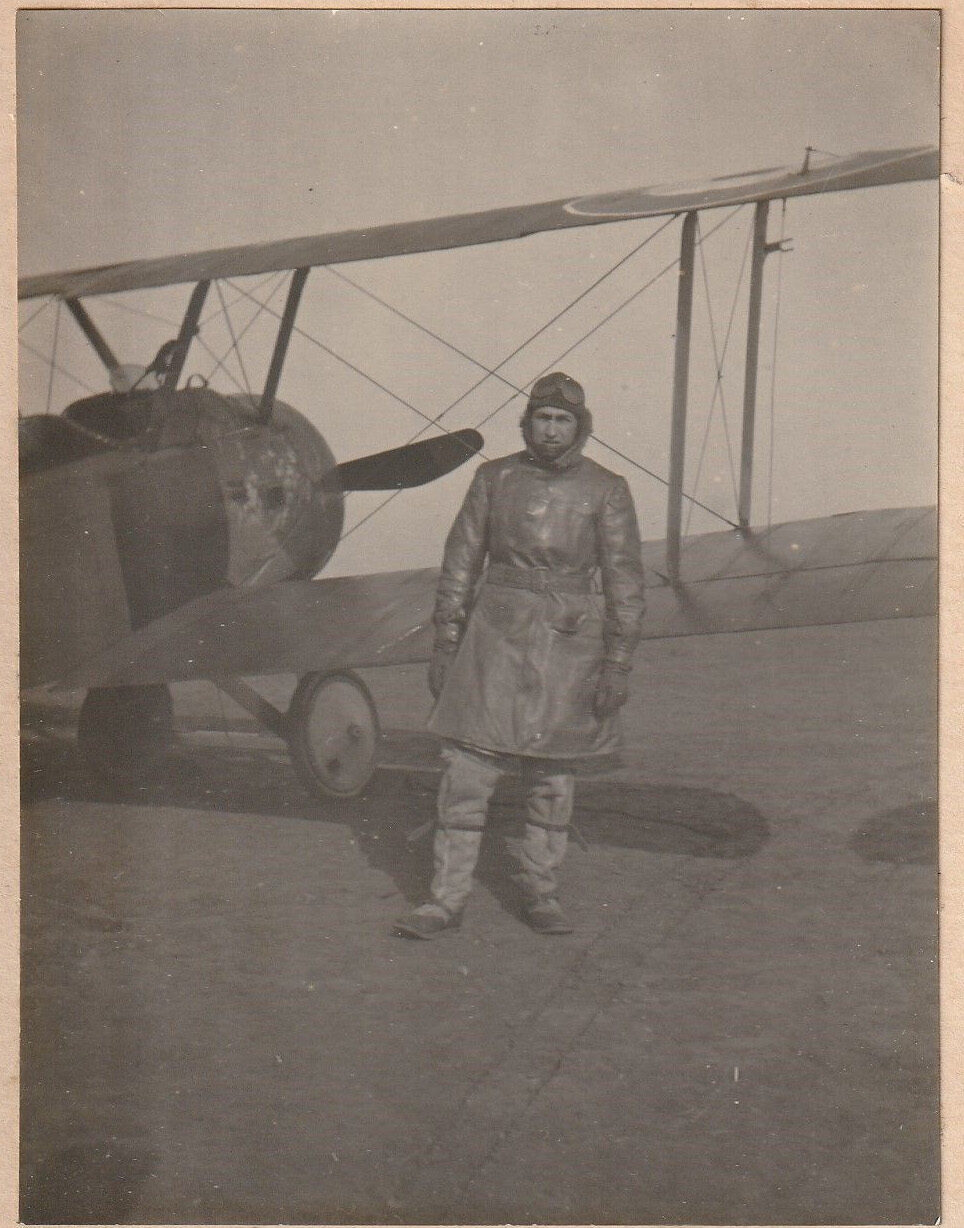
Another second Oxford detachment member, William Thomas Clements, was also assigned to Waddington with the expectation that he would become a DH.4 pilot. However, exceptionally, in the latter part of February, he was transferred to Scampton to train as a scout pilot. Something similar may have happened to Stanbery. In a letter from sometime in April 1918 he wrote that “I am glad to tell you that my period of training is nearly over and that I am about ready for the front. I was very lucky to be given a scout machine. It is very small and fast and difficult to land. My work at the front will be fighting, pure and simple.”20
Meanwhile there was the question of his commission. Pershing had been made aware that many cadets in Europe were unhappy that they had not yet been made first lieutenants. In a cablegram to Washington dated March 13, 1918, Pershing described the situation of the approximately 1400 aviation cadets in Europe, some of whom had waited three months to start flying training, and some of whom, after five months, were still waiting and might have to wait another four. “All of those cadets would have been commissioned prior to this date if training facilities could have been provided. These conditions have produced profound discouragement among cadets.” To remedy this injustice, and to put the European cadets on an equal footing with their counterparts in the U.S., Pershing asked permission “to immediately issue to all cadets now in Europe temporary or Reserve commissions in Aviation Section Signal Corps. . . .” Washington approved the plan in a cablegram dated March 21, 1918, but stipulated that the commissioned men be “put on non-flying status. Upon satisfactory completion of flying training they can be transferred as flying officers.” This explains why Pershing stipulated a status of “First Lieutenants Aviation Reserve non flying” in his April 8, 1918, cablegram recommending that Stanbery, along with thirty-eight other second Oxford detachment members, as well as many other cadets, be commissioned.
Washington took its time responding to Pershing’s April 8, 1918, cablegram. On April 30, 1918, Pershing wrote: “Request action taken on . . .” and lists cablegrams dated March 29 through April 8, 1918. The confirming cablegram from Washington, finally, is dated May 13, 1918.21 For Stanbery and most of the other second Oxford detachment members listed in the April 8, 1918, cablegram, the “non-flying” status was irrelevant, as they could attest to “satisfactory completion of flying training” well before the May 13, 1918, cablegram from Washington. In Stanbery’s case, he had graduated in the R.F.C. on March 27, 1918, meaning he had flown solo a specified number of hours and passed a number of tests, including flying at high altitude, making a cross-country flight, and flying a service machine.22
Stanbery presumably went on to either Ayr or Marske to learn aerial fighting and completed his training by mid April. It appears that he was then posted to the Central Despatch Pool in London for ferrying duty. There is a second-hand account of a letter written by him on April 25, 1918, with a mention of having just returned from “a long trial flight to France”—probably delivering a plane for use at the front.23
Fatal crash and afterwards
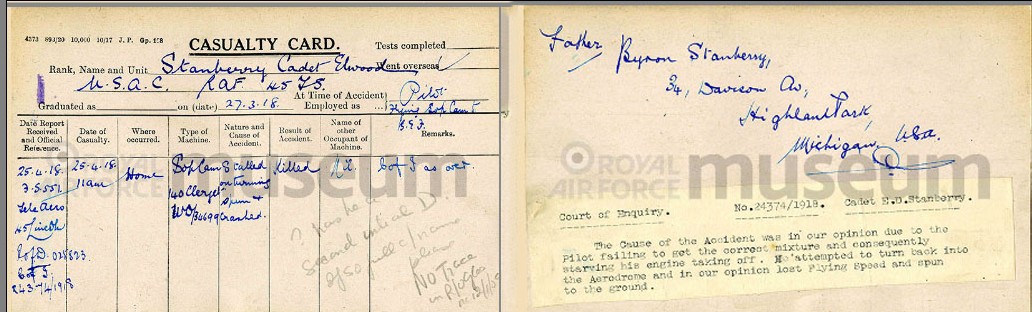
At some point, perhaps in anticipation of his imminent assignment overseas, Stanbery was posted to no. 45 Training Squadron at South Carlton, just north of Lincoln. On April 25, 1918, he was back at Rochford, presumably as part of his ferrying duties. Around 11 a.m. he was taking off in a Sopwith Camel that he was to deliver to the B.E.F., i.e., presumably to somewhere in France, when his engine began to stall (unusually, there is no record of the plane’s serial number). Stanbery attempted to turn back—something pilots were advised not to do in this situation. The plane went into a spin and crashed.24
The pastor of the Cliff Town Congregational Church at Southend-on-Sea, David Ewart James, was near Rochford at the time, and, as he recounted in a letter he wrote several days later, “saw him [Stanbery] fall and immediately rushed with a friend . . . to render any assistance I might be able to give . . . not a sound was heard after he fell and he was absolutely unconscious and quite beyond all human aid. He passed away within a very few moments quite peacefully and without a movement or a struggle.”25
Stanbery’s body was taken initially to a military hospital at Shoeburyness, southeast of Rochford and the air field. 26 From there he was taken back to Lincoln, and on April 30, 1918, buried in the Newport Cemetery there, in the “U.S.A. plot,” where Donald Elsworth Carlton, George Orrin Middleditch, and Joseph Hiserodt Sharpe had already been interred.27
Stanbery’s name appeared on the official casualty list on May 4, 1918.28 This was the day of the funeral for Asa Stanbery, the oldest Stanbery child, who had died of typhoid fever on May 2, 1918.29 The effect on the family of this double tragedy is beyond imagination.
After the war families of American war dead were offered the choice of leaving their deceased relatives’ bodies in European graves or having them returned to the U.S. The Stanbery family evidently requested that their youngest son be brought home. Stanbery’s body, as well as those of second Oxford detachment members Pudrith and Lloyd Ludwig, was transported on the Northern Pacific, which reached Hoboken on October 28, 1920.30 On November 15, 1920, Stanbery was reinterred in the Deerfield Cemetery.31
mrsmcq April 9, 2025
Notes
(For complete bibliographic entries, please consult the list of works and web pages cited.)
1 Stanbery’s place and date of birth are taken from Ancestry.com, U.S., World War I Draft Registration Cards, 1917–1918, record for Elwood D Stanbery. His place of death is taken from Ancestry.com, England & Wales, Civil Registration Death Index, 1916-2007, record for Elwood D Stanberry [sic]; his date of death is taken from “Stanberry [sic,] E. (Elwood).” See also the letter of David Ewart James, cited below. The photo is taken from p. 89 of Aurora 1915, the yearbook of Michigan State Normal College.
2 There are a good many sources related to the Stanbery (various spellings) family. Particularly relevant here is a citation of the will of Josiah Stanborough’s father on p. 166 of “Genealogical Research in England.” And see Howell, The Early History of Southampton, L. I., New York, pp. 15 and 16, regarding the date by which Josiah had arrived in America and his involvement with the founding of Southampton.
3 On the Stanberys and Divers, see documents available at Ancestry.com, as well as Pepper, “Ancestors of Barbara Ann Engel.”.
4 “Deerfield.”
5 “Elwood Stanbery Dies for Country”; “Deerfield Wins in Contest.”
6 See Stanbery’s draft registration, cited above.
7 “Elwood Stanbery Dies for Country.”
8 “Rep. Currie’s Page Killed in France.”
9 “Ground School Graduations [for August 25, 1917].”
10 “Letters From the Front.”
11 I believe I can identify Stanbery as the man eighth from the right in the middle row in a group photo of the Christ Church College cadets. There is also a photo kept by Payden of four cadets in quadrangle at Christ Church that includes Marvin Kent Curtis and Stanbery; Payden and Curtis are known to have roomed at Christ Church.
12 “Letters From the Front.”
13 Hooper, Somewhere in France, letter of November 4, 1917.
14 Chalaire, “Thanksgiving Day with the Aviators Abroad.”
15 Foss, Papers, “Cadets of Italian Detachment Posted Dec 3rd.
16 Philpott, The Birth of the Royal Air Force, pp. 250–51.
17 The National Archives (United Kingdom), Royal Air Force officers’ service records 1918–1919, record for Elwood D Stanbery.
18 “Learns to Fly in England.”
19 “Letter from Local Flier.”
20 “Elwood Stanbery was Popular with All his Acquaintances.”
21 See cablegrams 726-S (March 13, 1918), 955-R (March 21, 1918), 874-S (April 8, 1918), 1029-S (April 30, 1918), and 1303-R (May 13, 1918).
22 See Stanbery’s incident casualty card, “Stanberry [sic], E. (Elwood).”
23 “Funeral of Deerfield Boy was Impressive.”
24 “Stanberry [sic], E. (Elwood).”
25 This letter, or a copy of it, is in the possession of Stanbery family descendants.
26 “Letter Tells of Stanbery’s Death.”
27 Register of Burials in the Burial Ground of St. Nicholas-with-St. John.
28 “Four Michigan Men on Casualty List.”
29 “Attention, Masons!”; Ancestry.com, Michigan, Death Records, 1867-1950 [1952], record for Ara [sic] D Stanbery.
30 Ancestry.com, U.S., Army Transport Service, Passenger Lists, 1910-1939, records for Ludwig, Pudrith, and Stanberry [sic].
31 “Deerfield War Hero Given Military Burial.”