
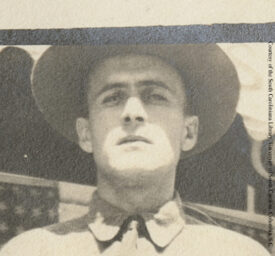
(Nashville, Tennessee, October 28, 1887 – Nashville, March 22, 1947).1
The Stokes family was originally English; various family members settled in Virginia and North Carolina.2 Sylvanus Stokes, great-grandfather of James Whitworth Stokes, purchased land in Tennessee with the intention of setting up his home there. With his family he set out from North Carolina in 1818 but died en route; the family continued on to Tennessee. One of Sylvanus Stokes’s sons, Jordan Stokes, became a highly respected lawyer in Lebanon, Tennessee, just east of Nashville. Jordan Stokes supported the Union in the Civil War, and it is perhaps evidence of his northern sympathies that one of his sons attended Amherst and another, Jordan Stokes, Jr., was at Princeton. The latter also became a lawyer; in 1877 he married Mary Adalyne Whitworth, herself the daughter of a Tennessee lawyer and granddaughter of a Sumner County, Tennessee, plantation owner.3 The couple had two daughters and three sons (the eldest son died as an infant4). James Whitworth Stokes was the youngest child.
Stokes is noted as having attended two Nashville area private schools: the Branham and Hughes School, and the Wallace School.5 He maintained his connection to the former, joining the Branham and Hughes Club at Vanderbilt University soon after beginning his studies there in the autumn of 1905.6 While at Vanderbilt, Stokes was also active in the Phi Kappa Psi fraternity, as had been his father and his brother, Jordan Stokes III.7 Initially Stokes pursued a B.S. and was in the class of 1909, but he went on to pursue a law degree, graduating with an LL.B. in 1910.8
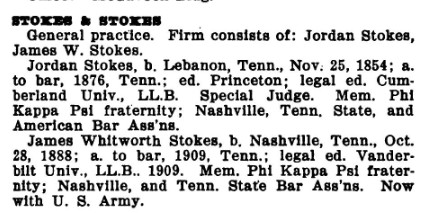
Stokes initially went into law practice with his father and his brother and then with his father only, when Jordan Stokes III established his own practice.9 Stokes remained with the firm of Stokes and Stokes into 1917.10 In the spring of that year he applied to and was accepted by the Aviation Section of the Signal Corps. In late June he was ordered to Urbana to attend ground school at the School of Military Aeronautics at the University of Illinois at Urbana.11
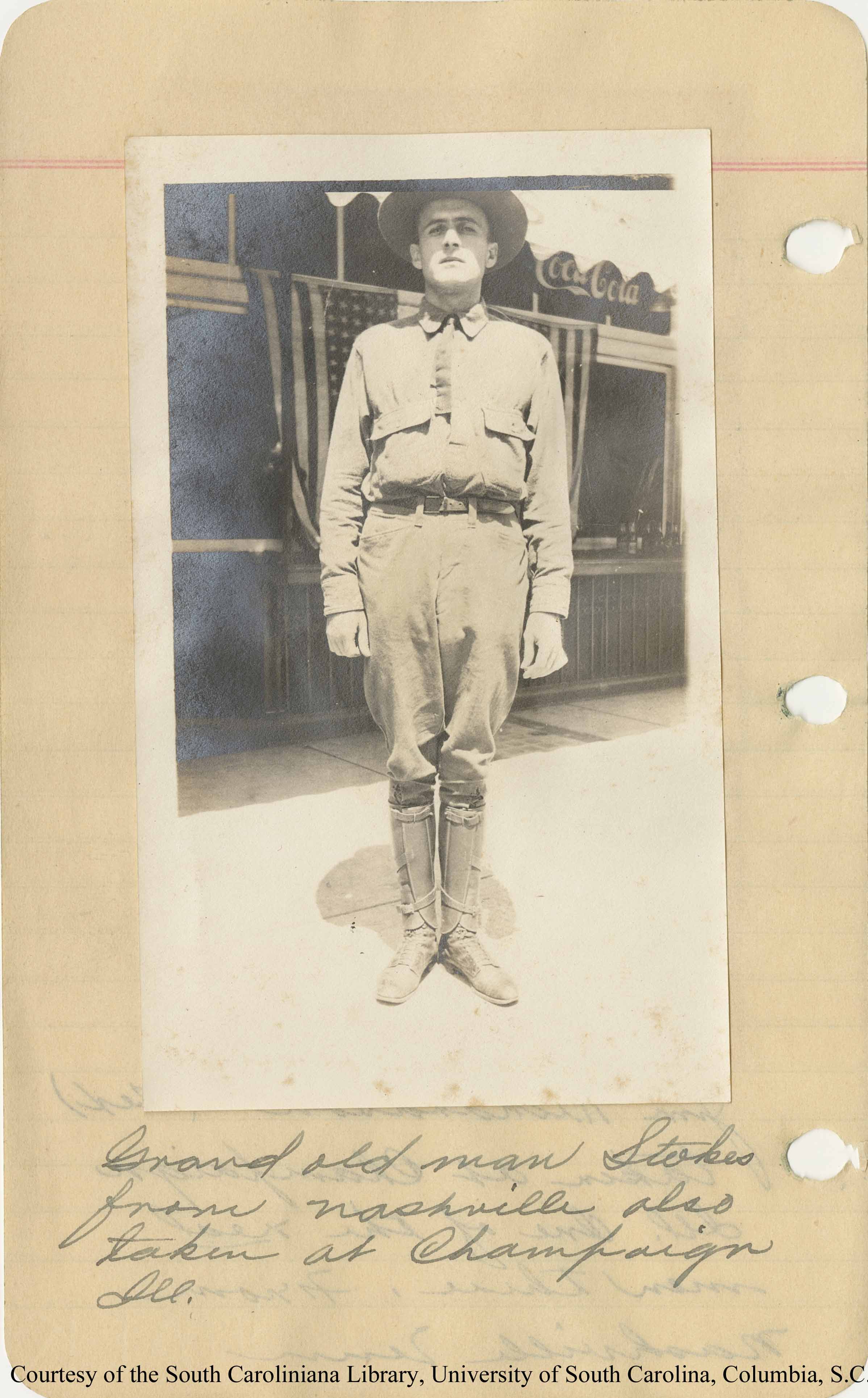
Stokes was in the ground school class that graduated August 25, 1917, the same class as his fellow southerner, John McGavock Grider, with whom he became friends.12 Government flight training facilities in the U.S. existed at this time mostly on paper, and offers from the Allies to train American pilots were welcomed. Around the time that Stokes’s ground school class graduated, there were openings in Foggia, Italy. About one third of the men in this class, including Stokes, chose or were chosen to go to Italy for flight training. They were thus among the 150 men of the “Italian detachment” who would set out for Europe in September. During the weeks between graduation and departure the men were based mainly at Mineola on Long Island whence they could make forays into Manhattan. Later, in England, Grider remarked in his diary that “Old man Stokes has just come in with a line about the McAlpine [sic] hotel & the Tokio [Restaurant] and the wild nights we spent in N.Y.”13
On September 18, 1917, the men of the Italian detachment went from Mineola to the west side of Manhattan and boarded the Carmania, a ship of the British Cunard line that had been turned into a troop transport ship. The Carmania initially headed up the east coast to Halifax. There she joined a convoy and, on September 21, 1917, began the Atlantic crossing. The men of the detachment travelled first class, and Stokes shared a state room with another southerner, Elliott White Springs.14 Except for daily Italian lessons conducted by Fiorello La Guardia, assisted by violinist Albert Spalding, the men had plenty of leisure. There were concerts in the evening, and also cards and gambling: “We had a big crap [sic] game later in our staterooms. First Jake [Julian Carr] Stanley took all the money and then Springs took it all from him and finally Stokes ended up with it all. I don’t know how much it was but there were a couple of handfuls of assorted paper.”15 Towards the end of the voyage, as the convoy entered particularly dangerous waters, the men were assigned to submarine watch duty which was, fortunately, uneventful.
Oxford
When the Carmania docked at Liverpool on October 2, 1917, the detachment learned that their Italian lessons had been for naught, as they were to stay in England for their training. There was initially considerable grumbling from some of the men about this change of plans, particularly when they realized that they would not begin flying immediately but would be put through ground school again, this time at the Royal Flying Corps’s No. 2 School of Military Aeronautics at Oxford University. In Grider’s case, however, the charms of England, the light work load—they would be repeating much of what they had already learned in the U.S.—and the ready availability of various kinds of drink were more than adequate compensation.16 It is likely that Stokes, who was rooming with Grider, Springs, and Laurence Kingsley Callahan in Oxford’s Christ Church College, felt the same.17 With their first round of ground school already behind them, they were in a position to assist other cadets at the Oxford S.M.A. Grider broke off writing one of his early diary entries there because “Jim [Stokes] & Larry [Callahan] are trying to teach a boy from south Africa wireless in here.”18
Soon after their arrival, the men of the Italian detachment realized that they were the second detachment of American cadets to come to Oxford for training; 50 men had arrived a month previously. Accordingly the quondam Italian detachment came to be called the “second Oxford detachment.” Having arrived midweek, they were able to spend their first few days exploring the university, the town, and the surrounding countryside, and only began classes on Monday, October 8, 1917. The previous evening, according to Grider, “The party of Jim Stokes, Springs, Callahan, Lieut Webber [unidentified] & myself was a success Mitre Hotel supper & Champaign at 2’10 per qt.,” in contrast to the next evening when “Larry, Stokes & Springs went to supper & the show tonight. dismal failure.”19 Stokes’s previous luck at craps seems to have been no fluke; Grider notes in his diary on October 12, 1917, that “I lost 40.00 in a crap game last night & Jim Stokes won about 300.00.”20
The men of the detachment socialized quite a bit with the people of Oxford. Grider mentions that “Ten of us went to a beautiful dance Tuesday night at Miss Cannon’s an English real girl who wears a monocle” and later adds that “Jim Stokes came to Miss Cannon’s dance illuminated and did an indian war dance in the middle of the dance floor. Jim has nearly died over the kidding he got today.”21 On another evening, “Stokes and I went to dinner tonight with Lieut. Vaudrey [Vandrey?] at Keble College. It felt strange to walk through that dining room with about 400 cadets and take a seat at the officers table.”22
About a month after their arrival in England, the men learned that their time at Oxford was up. Twenty were selected to go to Stamford to start flying, while the others were ordered to attend machine gun school at Harrowby Camp near Grantham in Lincolnshire and were to depart on November 3, 1917. Stokes, however, joined neither group: William Ludwig Deetjen, about to leave for Stamford, wrote in his diary on November 4, 1917, that “Jim Stokes stays behind in the hospital for an operation. Poor lad.” Grider, now at Grantham, wrote in his diary on November 6, 1917, that “Poor old Jim Stokes is in the hospital at Oxford for Hernia. . . . I miss old Jim Stokes. . . .” The entry in War Birds for November 6, 1917, reports that “We had to leave poor Jim Stokes behind. He was operated on for appendicitis the day we left. He got through it all right.”
London and later
The operation, whatever it was for, apparently put paid to Stokes’s chances of learning to fly. I find no official documentation of his further activities, but newspaper accounts indicate that he was assigned to the Judge Advocate General’s Department in London, where his legal background and skills could be put to use.23 The War Birds entry for January 1, 1918, recalling events since the previous entry of December 6, 1917, remarks that “We met Jim in London and had a wild party. Jim is living there now and is attached to Headquarters.”24 Stokes is also mentioned in the January 1, 1918, entry in Grider’s original diary: “Larry & I met old Jim Stokes in London and we had a wild party. Jim took on L.L.L.D. Larry had Peggy. . . .” (Clarence Horne Fry had given the name “Long lean lanky devil” to one of the women they socialized with.)
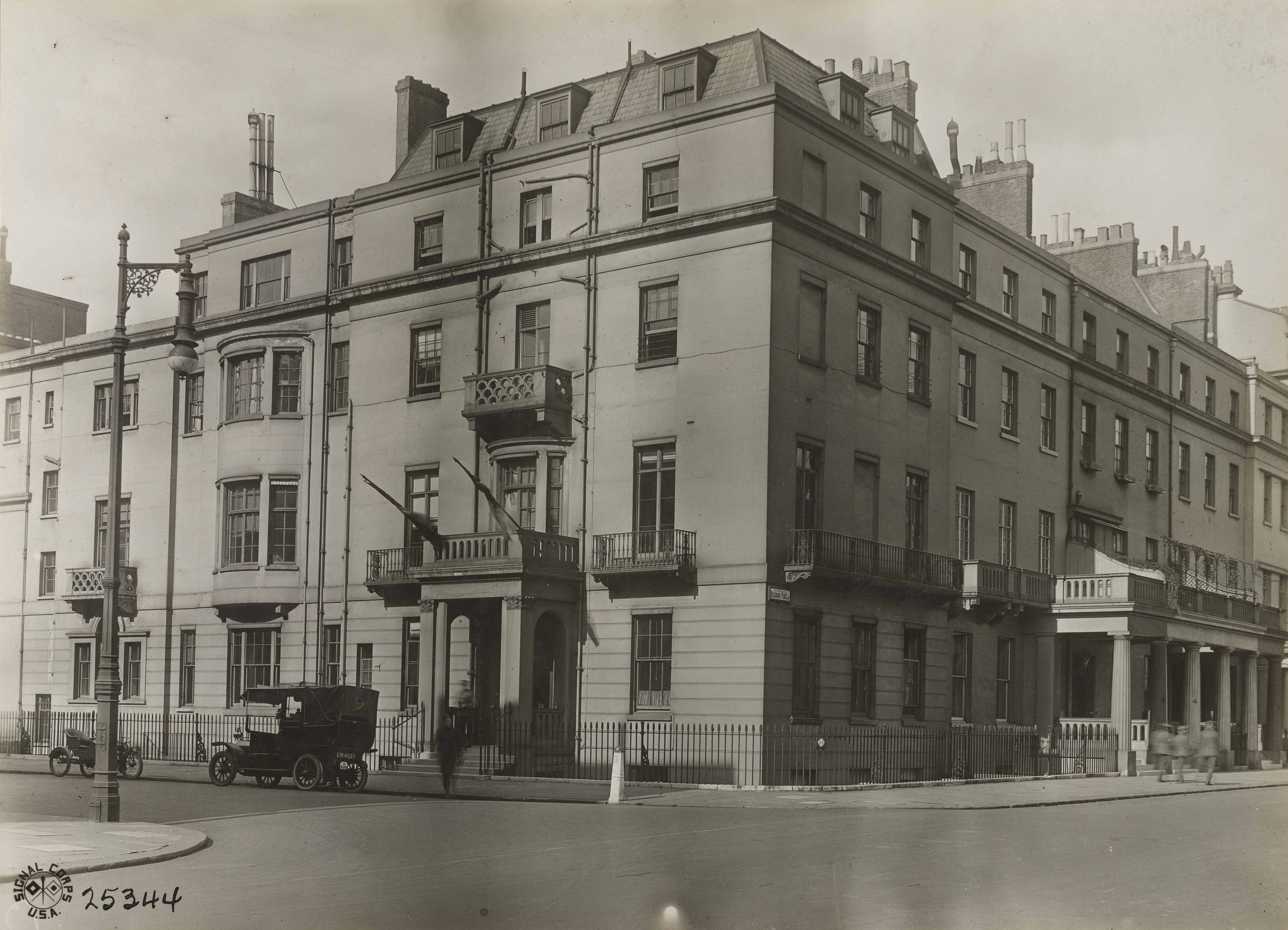
Information about Stokes in the early spring of 1918 comes from the diary of Joseph Kirkbride Milnor, who had also been forced to take a ground job. Milnor reported to American Aviation Headquarters at 35 Eaton Place on March 4, 1918, where he encountered Stokes, who “sent me around to the Red Court Hotel, 19 Bedford Place where he and Capt. Swann are staying. . . . ” (John Warren Swann had been supply officer on the Carmania during the voyage to England and became the disbursement officer at the American Aviation Headquarters in London.) A few days later, on March 7, 1918, Milnor noted that “Jim & Capt. Swann have left to take an apartment so I moved into Jim’s old room, No. 18 on the Ground floor. A nice big double room . . . .”25
On April 8, 1918, Stokes’s name appears in a long list of men recommended for their commissions as first lieutenants “non-flying.” In this instance “non-flying” had nothing to do with Stokes’s having had to give up training, but rather with sclerotic wartime training and bureaucracy. A month previously Pershing, who had been made aware that many aviation cadets in Europe were unhappy that they had not yet been made first lieutenants, sent a cablegram to Washington describing the situation of approximately 1400 men whose flying training was delayed: “All of those cadets would have been commissioned prior to this date if training facilities could have been provided. These conditions have produced profound discouragement among cadets.” To remedy this injustice, and to put the European cadets on an equal footing with their counterparts in the U.S., Pershing asked permission “to immediately issue to all cadets now in Europe temporary or Reserve commissions in Aviation Section Signal Corps. . . .” Washington agreed, finally, on May 13, 1918, but stipulated that the men be commissioned first lieutenants “non-flying”: “Upon satisfactory completion of flying training they can be transferred as flying officers.”26
Other information about Stokes comes from the diaries of Deetjen and, again, Milnor. On April 17, 1918, the former was summoned to London to be reprimanded for violating censorship rules. After a slap on the wrist, he met up with a number of men from the detachment who were also in London, including Stokes.27 Milnor mentions dinner with Stokes on June 23, 1918; the previous day he (Milnor) had learned that Grider was missing and probably passed this news on to Stokes. On July 3, 1918, Milnor wrote in his diary that “Jim Stokes is at his old apartment on Ebury Street, about four squares from the office [35 Eaton Place] and as he has two extra rooms I’m going to share it with him. . . . Jim has a maid to get breakfast or any other meal he wants. . . . It is awfully cheep [sic] too but we don’t know how long we can stay in it, as the owner may come back at any time. At any rate we will be comfortable while we are here.” Recalling the period from the ninth of July through the fourteenth, Milnor describes how “Jim and I have spent most of our evenings winning the war or rather deciding how it should be won”28 The next day, July 15, 1918: “Jim left for the rest camp at Lingfield [?].” If I have read Milnor’s handwriting correctly, Stokes was probably going to the American Red Cross Convalescent Hospital No. 101, which had been opened at the end of June by Pauline Spender-Clay, née Astor, at her country home, Ford Manor, southeast of Lingfield in Surrey.29 I find nothing to indicate whether Stokes was going there as a convalescent or in his official capacity.
The next information about Stokes comes from American newspaper articles from May 1919, which indicate he had been promoted to captain and that he had been appointed first assistant to the military attaché to the Court of St. James, i.e., he was a member of the diplomatic corps at the U.S. embassy in London.30 A later article indicates that the diplomatic appointment was made after the armistice.31
Stokes sailed back to the U.S. in September 1919, departing from Brest on September 6, 1919, and arriving at Hoboken nine days later.32 His point of departure suggests his work may have taken him from England to France. Returned to Tennessee, Stokes resumed practicing law in Nashville. 33
mrsmcq April 10, 2026
Notes
(For complete bibliographic entries, please consult the list of works and web pages cited.)
1 Stokes’s dates and place of birth and death are taken from Ancestry.com, Tennessee, U.S., Death Records, 1908-1965, record for James Whitworth Stokes. His year of birth is sometimes given as 1888, but see (in addition to the preceding) Ancestry.com, U.S., Headstone Applications for Military Veterans, record for James W Stokes; and Ancestry.com, 1900 United States Federal Census, record for James Stokes. The image is cropped from a photo on leaf 11v of Grider’s Diary October 3, 1917 – February 7, 1918, courtesy of the South Caroliniana Library, University of South Carolina, Columbia, S.C.
2 Information on the Stokes family is taken from “Hon. Jordan Stokes, Lebanon” and documents available at Ancestry.com. I should note that both the senior and the junior Jordan Stokes are sometimes given the middle name Green, but I find no original documentation that does so. It is, however, worth nothing that Sylvanus Stokes’s paternal grandfather was the North Carolina Methodist minister Green Hill.
3 Ancestry.com, Tennessee, U.S., Wills and Probate Records, 1779-2008, record for James Whitworth.
4 “Mrs. Mary W. Stokes Dies,” p. 2.
5 “James W. Stokes, Attorney, Dies.”
6 The Vanderbilt Comet 1906, p. [244].
7 The Vanderbilt Comet 1905, p. 163.
8 See listing of Phi Kappa Psi men on p. [205] of The [Vanderbilt] Comet 1908; The [Vanderbilt] Commodore 1909, p. 188; and The [Vanderbilt] Commodore 1910, p. 112.
9 See “Stokes & Stokes” in the Nashville City Directories for 1911 and 1912.
10 See “Stokes & Stokes” in the Nashville City Directory for 1917.
11 “Nashville Boy Enters Service” and “Jas. Stokes Ordered to Aviation School.” NB: I have not found a draft card for Stokes.
12 “Ground School Graduations [for August 25, 1917].”
13 Grider, Diary October 3, 1917 – February 7, 1918, entry for October 12, 1917. Also staying at the McAlpin with Grider and Stokes were their ground school classmates Walter Ferguson Halley and Marvin Kent Curtis; see Curtis’s letter of June 2, 1918, to his sister Josephine.
14 War Birds, entry for October 3, 1917.
15 War Birds, entry for September 29, 1917.
16 See the opening pages of Grider, Diary October 3, 1917 – February 7, 1918.
17 On the roommates, see War Birds, entry for October 3, 1917; see also Grider and Jacobs, Marse John Goes to War, p. 63 (letter of October 9, 1917), as well as Grider, Diary October 3, 1917 – February 7, 1918, leaf [4r].
18 Grider, Diary October 3, 1917 – February 7, 1918, leaf [5r].
19 Grider, Diary October 3, 1917 – February 7, 1918, leaves [8v], [9r].
20 Grider, Diary October 3, 1917 – February 7, 1918, leaf [13v]. It is also possible that Springs repurposed this entry for the September 29, 1917, entry in War Birds.
21 Grider, Diary October 3, 1917 – February 7, 1918, leaves [18v] and [20r]. This is the entry for October 30, 1917. Grider also recounts this incident in a letter to his sister dated November 1, 1917 (Grider and Jacobs, Marse John, pp. 68– 69). I have not been able to identify Miss Cannon.
22 Grider, Diary October 3, 1917 – February 7, 1918, leaf [19r]. See also the letter of November 1, 1917, mentioned above, where the man is referred to as “Lieut. Vadney of the British Infantry.” I have not been able to identify the lieutenant.
23 See, for example, “Capt. Stokes Wins Big Honor.”
24 He was thus apparently at American Aviation Headquarters in London, on the staff of the J.A.G. Department, which was associated with Base Section No. 3, Service of Supply. See Organization of the Services of Supply American Expeditionary Forces, p. 30 and passim, and Borch, Judge Advocates in the Great War.
25 See Milnor’s diary entries for March 4 and 7, 1918.
26 See cables 874–S and 1303–R.
27 Deetjen, diary entry for April 17, 1918.
28 Milnor, diary entry for July 9 to July 14, 1918.
29 “Home for Convalescents.”
30 “Capt. Stokes Wins Big Honor; “Capt. Stokes Wins Diplomatic Honors.”
31 “Captain Tells of British Labor.”
32 War Department, Office of the Quartermaster General, Army Transport Service, Lists of Incoming Passengers, 1917 – 1938, passenger list, S.S. America, departing Brest September 6, 1919
33 “James W. Stokes, Attorney, Dies.”