
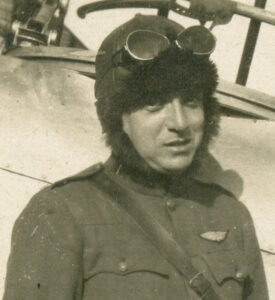
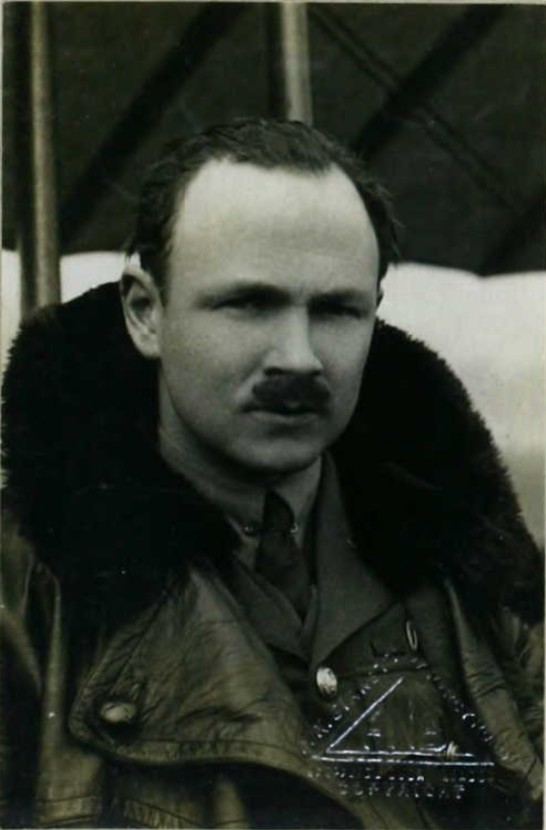
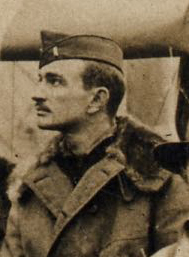
(Burlington, Vermont, March 13, 1892 – Plattsburgh, New York, July 25, 1918). 1
Oxford ✯ Grantham ✯ 76 H.D. Squadron ✯ Waddington ✯ U.S. commission, R.A.F. graduation ✯ Marske; No. 117 Squadron R.A.F. ✯ France and the 166th Aero ✯ Over the lines ✯ Coming home
The Stoughtons can be traced back to a Thomas Stoughton and his son, also Thomas, who emigrated from England in the early 1630s and settled in what is now Connecticut.2 A descendant, John Stoughton, served in the Revolutionary War, as did his son Gustavus.3 Father and son moved sometime around 1800 to New York state. A grandson of Gustavus Stoughton, Alansing Guy Stoughton, relocated mid-century to Burlington, Vermont, where he worked as a master stone mason; he served in the Vermont 1st Cavalry during the Civil War. His son, the improbably named Augustus Caesar Stoughton, Perley Melbourne Stoughton’s father, also served in the cavalry on the Union side, having enlisted at the age of fifteen.
After the war A. C. Stoughton continued to live in his birthplace, Burlington, and worked variously as a mason, a marble cutter, a painter, and a railroad baggage master; he was active in Burlington politics and in the local post of the Grand Army of the Republic.4 In 1883 he married Harriet Adele Patnod, daughter of another Vermont Civil War veteran, Charles Joseph Patnod.5 The latter had been born in Quebec, but came to Vermont at an early age, settling in Rutland. Harriet (also known as Hattie) and Augustus Caesar Stoughton had three children who survived infancy and childhood: Mary Ann (May), Carl, and Perley Melbourne Stoughton. The name Perley apparently came down in his mother’s side of the family; she had a brother named Perley Peter Patnod. A cursory search finds no person named Melbourne in the Stoughton family, suggesting that this name also came from the less well-documented Patnod side.
Perley Melbourne Stoughton attended Burlington Grammar School and Burlington High School.6 He did not attend college but instead began working for The Burlington Free Press, rising from proofreader in 1910 to reporter, his occupation when he registered for the draft on June 5, 1917.7
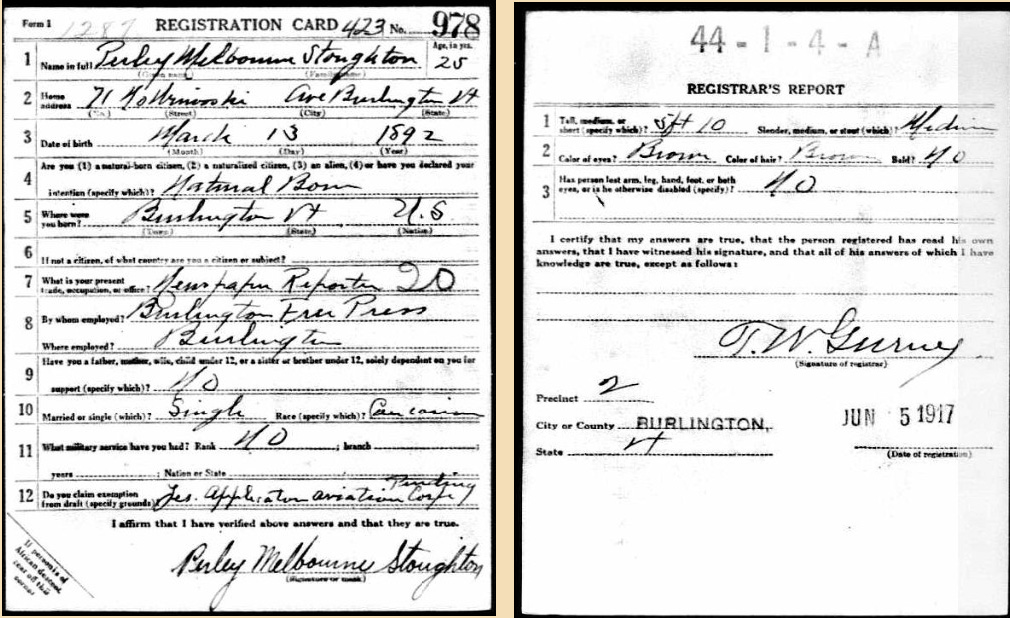
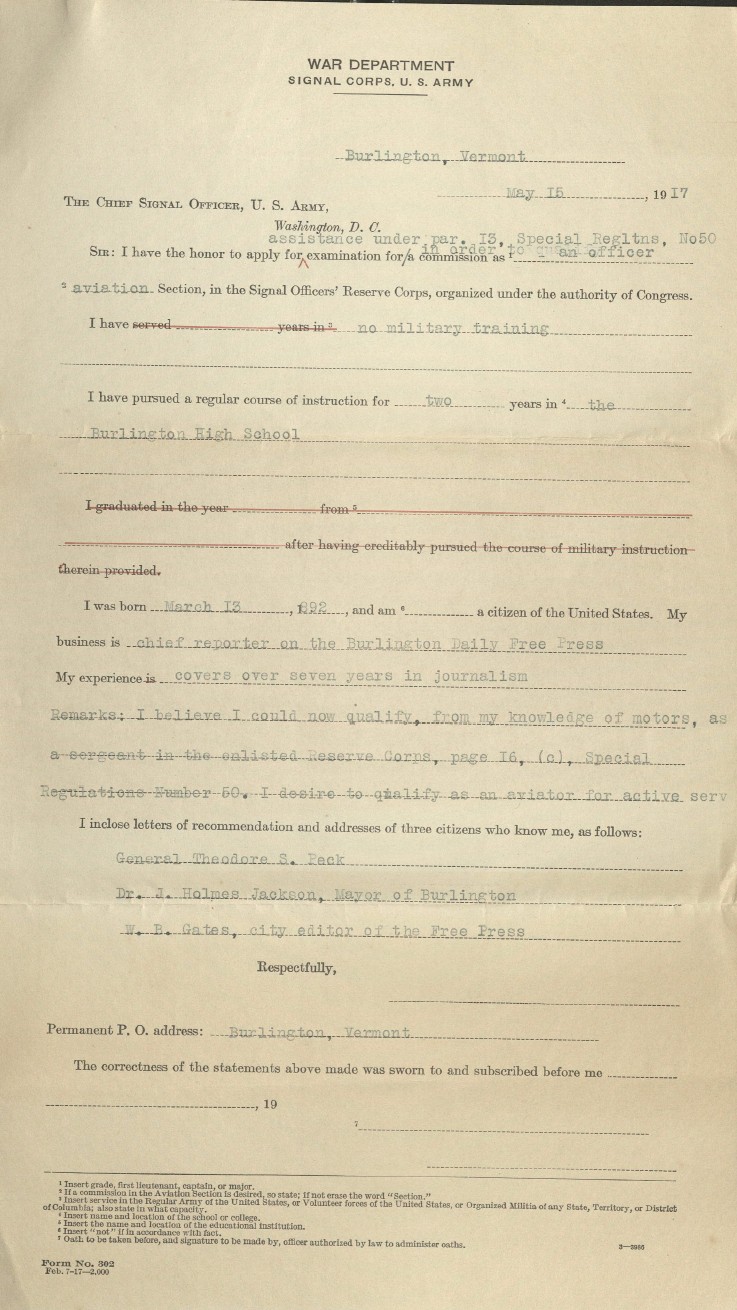
Three weeks prior to registering, Stoughton had applied to the Aviation Section of the Signal Corps; he noted he had no military experience, but had “knowledge of motors, as a sergeant in the enlisted Reserve Corps.”8 He was accepted and set off for Massachusetts on June 18, 1917, having been assigned to ground school at the School of Military Aeronautics at M.I.T.9
The evening of his arrival the next day, Stoughton wrote to his mother. This was the first of many letters to this much beloved parent. His concern not to upset or worry her means that his letters are short on details of his military life, and that, once overseas, he was very mindful of censorship rules. Nevertheless the letters provide a reasonable amount of information about his activities. In this letter of June 19, 1917, Stoughton notes having visited Harvard’s Stoughton Hall, named for William Stoughton, a governor of Massachusetts and Perley Melbourne Stoughton’s cousin many times removed.10
Stoughton’s letters indicate he enjoyed ground school. Unlike many of the students, he made quick progress in learning “wireless” (Morse code) and liked the obligatory exercise and military drills.11 He was evidently a personable young man who enjoyed the company of those with whom he came into contact at school and during outings made when he had time off. In particular, he, along with some other students, was taken up by Ella Greenslet, wife of Ferris Lowell Greenslet of Houghton Mifflin Publishing. She was so impressed by Stoughton that she decided to turn over to him and his classmates her Beacon Hill house for the summer.12
August brought exams and much speculation as to where the men would be sent for their flying training. It looked as though men from his class would be sent to Mineola, an Air Service training center on Long Island, but Stoughton hoped to be sent for flight training to another center, Mt. Clemens in Michigan. He also, however, when the opportunity arose, signed up for training in Italy, “the Italians are the best flyers in the world & in all likelyhood [sic] the Americans who are taught to fly over there will be sent right back here as instructors. . . .”13 Stoughton was presumably hoping to reassure his mother that he would not be abroad for long.
Stoughton was among those who “fell down” on one ground school exam. He assumed, correctly, that the problem had been map reading, which involved a lot of math; he felt confident, again correctly, that he had done well in the other exams. The one poor exam result seems to have led to his being held over and not actually graduating with his August 18, 1917, cohort.14 A week later he retook the exam and a few days after that was able to report having passed all his exams. He “was being held only for orders. They seem to be very slow at Washington about sending them along.”15 Stoughton would learn that delay was the rule rather than the exception in the military.
Finally, on September 5, 1917, Stoughton was able to report to his mother that he, along with twelve others, had that morning received orders to go to Fort Wood on Bedloe Island in New York Harbor in anticipation of being sent to France for flying training. On September 12, 1917, however, plans once again changed. Stoughton wrote from Mineola the next evening that “they required about thirty to fill out the Italian quota and so we were lucky enough to be eleven to fill out.”
The evening of September 17, 1917, Stoughton wrote that “We think we go to Halifax, to England, to France and then by sail to Italy.” And, indeed, the next day the 150-man strong “Italian detachment” boarded the Cunard liner, Carmania, and set off for Halifax. There the ship joined a convoy for the Atlantic crossing, setting out September 21, 1917. The men of the detachment travelled first class and had plenty of leisure. Stoughton wrote on shipboard on October 1, 1917, that “I am almost across the ocean . . . The voyage has been very uneventful in fact there has not been one exciting moment . . . It has been a case mostly of sleeping and eating, and I have done both to perfection.” Other activities (unmentioned by Stoughton in the extant letters) included Italian lessons conducted by Fiorello La Guardia, assisted by violinist Albert Spalding, and, towards the end of the voyage, as the convoy entered particularly dangerous waters, submarine watch duty. Stoughton seldom mentions his fellow detachment members by name, but in the letter of October 1, 1917, he makes reference to “Hamilton, the minister’s son,” i.e., Lloyd Andrews Hamilton, who had also been at M.I.T., and whose career Stoughton would follow with admiration. In 1917 or early 1918 Hamilton’s parents moved from Pittsfield, Massachusetts, to Burlington, Vermont, where they resided for several years and were friends or acquaintances of at least the senior Stoughtons.16
On October 2, 1917, the Carmania arrived at Liverpool, at 4 A.M., according to a sketchy diary kept by Stoughton.17 By 5:45 that evening, again according to his diary, the detachment was in Oxford; Stoughton spent that night in Jesus College. Three days later he wrote his mother that “No doubt it is a surprise to you to learn that we are here at Oxford. There was no doubt but that we were started for Italy and no one new [sic] there was to be a change in plans until we reached Liverpool . . . . We are here for at least six weeks for the purpose of taking a course just about the same as that at M.I.T. so you see it is just about the same as starting all over again.” They were to go through ground school, again, at the Royal Flying Corps’s No. 2 School of Military Aeronautics at Oxford. That it would be “just about the same” is no surprise, as the U.S. S.M.A.s based their curriculum on that of the R.F.C. The repetition meant that the Americans did not have to work very hard, but many of them came to appreciate the fact that at Oxford they were taught by men who, unlike those in the U.S., had actual flying and combat experience.
After their first night in various colleges, the men were divided into two groups: ninety were housed in Christ Church College with Elliott White Springs in charge of them, and sixty, including Stoughton, in Queen’s College in the charge of William Ludwig Deetjen—whom Stoughton knew from M.I.T.18 It was apparently at Queen’s that Stoughton became friendly with Fremont Cutler Foss; the latter mentions Stoughton frequently in his diary, and it appears that they roomed together.
Having arrived too late for classes the first week of October, the men had several days of leisure. The afternoon of October 5, 1917, along with George Dana Spear, also rooming in Queen’s, Stoughton set out to take photos and explore Oxford, in particular Christ Church Cathedral. They encountered a kind cleric who showed them around the church and his private garden and invited them to tea.19 The next day, Saturday, in the morning, the men got their schedules for the following week; in the afternoon Stoughton and Foss walked northwest along the Thames towards the aerodrome at Port Meadow, stopping at the Trout Inn for refreshment. As it was getting late, they forewent a visit to the air field, but on their way back, they encountered two R.F.C. lieutenants who offered to take them up for a “flip” (plane ride) the next day. The weather turned out to be too bad for flying on Sunday, but Stoughton and Foss got a thorough tour of the aerodrome.20
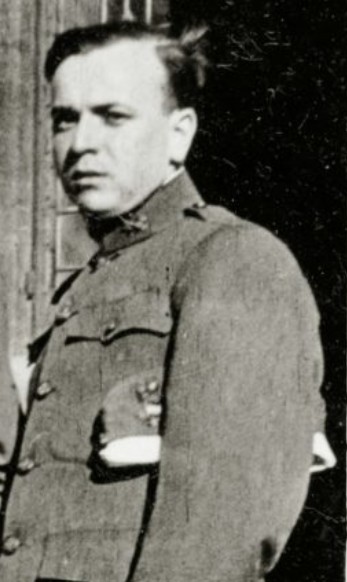
The following Sunday Stoughton and four others rode bicycles out to Woodstock to see Blenheim Palace; Stoughton had by now purchased and was writing on paper with the R.F.C. Queen’s College letterhead. This was before the men learned that, as a result of an inspection by American brass on the fourteenth, they were expected to “buy a new outfit, clothes, shoes, etc. which will set us back about $50 or $60.” In place of their broad-brimmed campaign hats they were now to wear R.F.C. caps, which Stoughton describes as “the dinkiest little hat you ever saw.”21 The next Sunday, Stoughton wore the new whipcord outfit to go to church and later that day, “at inspection the major stopped in front of me & remarked to his staff ‘A jolly fine kit that fellow has,’ which is quite some compliment coming from him.”22 Indeed, Foss recorded the following Sunday: “C.O.’s parade. Some of the boys got hell for having uniforms off regulation.”
In a letter to Fletcher Severance Perry—a man about Stoughton’s age who boarded with the Stoughtons and was treated as a member of the family—Stoughton complains about the lack of amusement in Oxford. But he goes on to remark that “the surrounding country is fine” and that in addition to bicycling, “I . . . also canoe on the River Thames.”23 Foss mentions “a canoe ride with Duic [sic; sc.: Frank Aloysius Dixon?] and Stoughton” on October 20, 1917. The next day Foss and Stoughton were once again on bicycles, this time going as far as Dorchester-on-Thames, nine miles to the south of Oxford. “We stopped in an inn there and had refreshments and came home. Stayed in Sunday night.”24
That was to be their last night in Queen’s. On Saturday evening, members of the first Oxford detachment, 50 Americans who had arrived in early September, as well as a number of men from the “Italian” or, now, “second Oxford detachment,” had held rather wild parties in the town and thereby annoyed the Oxford S.M.A. Commandant, Colonel Bertram Richard White Beor. After receiving a severe dressing down, the Americans were told they were all to be housed together in the same college, Exeter, under the watchful eye of Lieutenant Geoffrey James Dwyer, who was charged with overseeing American aviation training in England. Foss remarks that “We–the same 5 got a good room: 12-6”—the five being himself and, presumably, Stoughton, Spear, Leo McCarthy, and Dixon.25
A number of families living in Oxford welcomed the Americans into their homes. On the last Sunday in October, Foss noted that “In the afternoon we took a walk along the Thames and went to Mrs. Anderson’s tea, 50 Woodstock Road.” An entry in Stoughton’s pocket diary for this day also notes “tea at Mrs. Andersons.” This was Mrs. Robert Anderson (née Clara Mitchell Ellis), a widow from Cincinnati, who was spending the war years in England, where her children were being educated.26
As Stoughton had noted in his letter home of October 5, 1917, the men of the second Oxford detachment had been given to understand that they would spend six weeks at Oxford. In fact, they remained only a month. On November 1, 1917, “Dwyer announced today that on Saturday 130 of us will be posted at Grantham School of Machine Gunnery. The rest will go to Stamford.”27 Those chosen for Stamford to begin flying training were mainly men who had already had some flying experience in the U.S. and thus did not include Stoughton. He and the others dealt with their disappoint as best they could, aware of the shortage of places at training squadrons. Second Oxford detachment member Parr Hooper remarked that they were off to Grantham “because there was no other place to send us to—playing for time.”28
The next day, November 2, 1917, Foss wrote in his diary that “We are ordered to procure officer’s kits. Stoughton and I scoured the town for cots, bedding rolls, etc. At last we got fitted out. Cost like hell but we got them.”29 Fortunately the men were paid later that day; for Stoughton, as for many of the men, the required expenditures and the irregular and uncertain pay created ongoing financial worries. In the evening he, Foss, and their friends McCarthy, Dixon, and Donald Swett Poler, having learned that Dixon would not be going to Grantham, held a bibulous farewell celebration.30
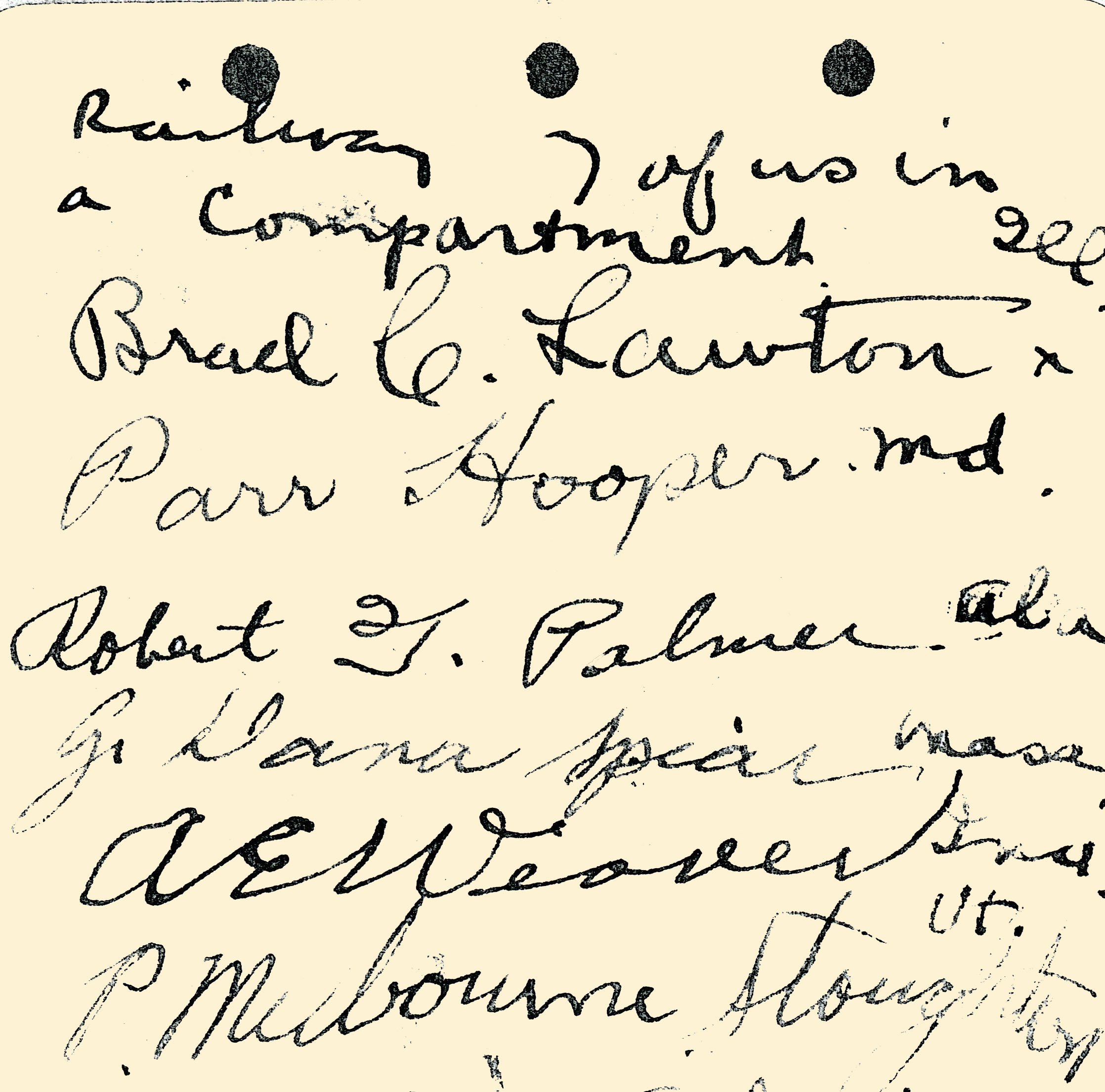
The morning of November 3, 1917, those bound for Harrowby Machine Gunnery Camp near Grantham in Lincolnshire boarded their train at Oxford. Stoughton and Foss shared a compartment with Hooper, Bradley Cleaver Lawton, Robert Thomas Palmer, Spear, and Albert Elston Weaver. Foss collected their signatures in his diary. It took about six hours to get from Oxford to Grantham, with an hour’s stop at Bletchley in Buckinghamshire. On arrival at Grantham around 3:30 the men were welcomed with a band and music to which they marched to the camp. Stoughton, Foss, Spear, and Walter Andrew Stahl were assigned to hut 39, with Stahl in charge.31
The next day, as they had done on arrival at Oxford, Stoughton and Foss made a bee-line for the nearby air field, in this case Spittlegate southeast of Grantham, and Stoughton had his first experience flying, going up as a passenger in a DH.6, a two-seater plane designed for training purposes.32 Stoughton later wrote his mother that “[I] Was up for my first ‘flip’ . . . . I got acquainted with one of the flight commanders at a nearby aerodrome & he took me up. It is the most wonderful thing in all the world & you may be sure that I enjoyed it to the limit. Was up about 20 minutes, which is a nice little ride.”33 On November 18, 1917, in a letter to Anna Irene Brophy, his mother’s sister, Stoughton wrote that “I have had several flights, thanks to the courtesy of some English Officers with whom I have made friends and I have controlled the machine in the air . . . .”34
Of Harrowby Camp itself, Stoughton wrote: “This is by far the best place to live that I have yet struck. Quarters are comfortable, food excellent, good baths & fine hospitable officers. We are rated as officers. . . . We wear all our officers insignia, except the [lieutenant’s] bars on the shoulders.”
Classes the first two weeks were devoted to learning about and practicing with the Vickers machine gun. The evening of their first day of classes on November 5, 1917, Stoughton, Foss, and Weaver went to the Empire Theatre & Theatre Royal in Grantham to see Henry Francis Maltby’s “The Rotters”; a little over the week later Stoughton and Foss saw “The Maid of the Mountains.”35 Stoughton was able to get leave to travel to London the weekend of November 10–11, 1917. His main object was to look up his friend from the Burlington Free Press, William Thomas Powell. Bill Powell, a Canadian, had joined the Royal Canadian Horse Artillery and gone overseas with the Canadian Expeditionary Force in April 1917; he was now stationed at Wiltby Camp, southwest of London.36 On returning to London from seeing Powell in Guildford (near Wiltby), Stoughton enjoyed exploring London from his base at the Savoy Hotel.37
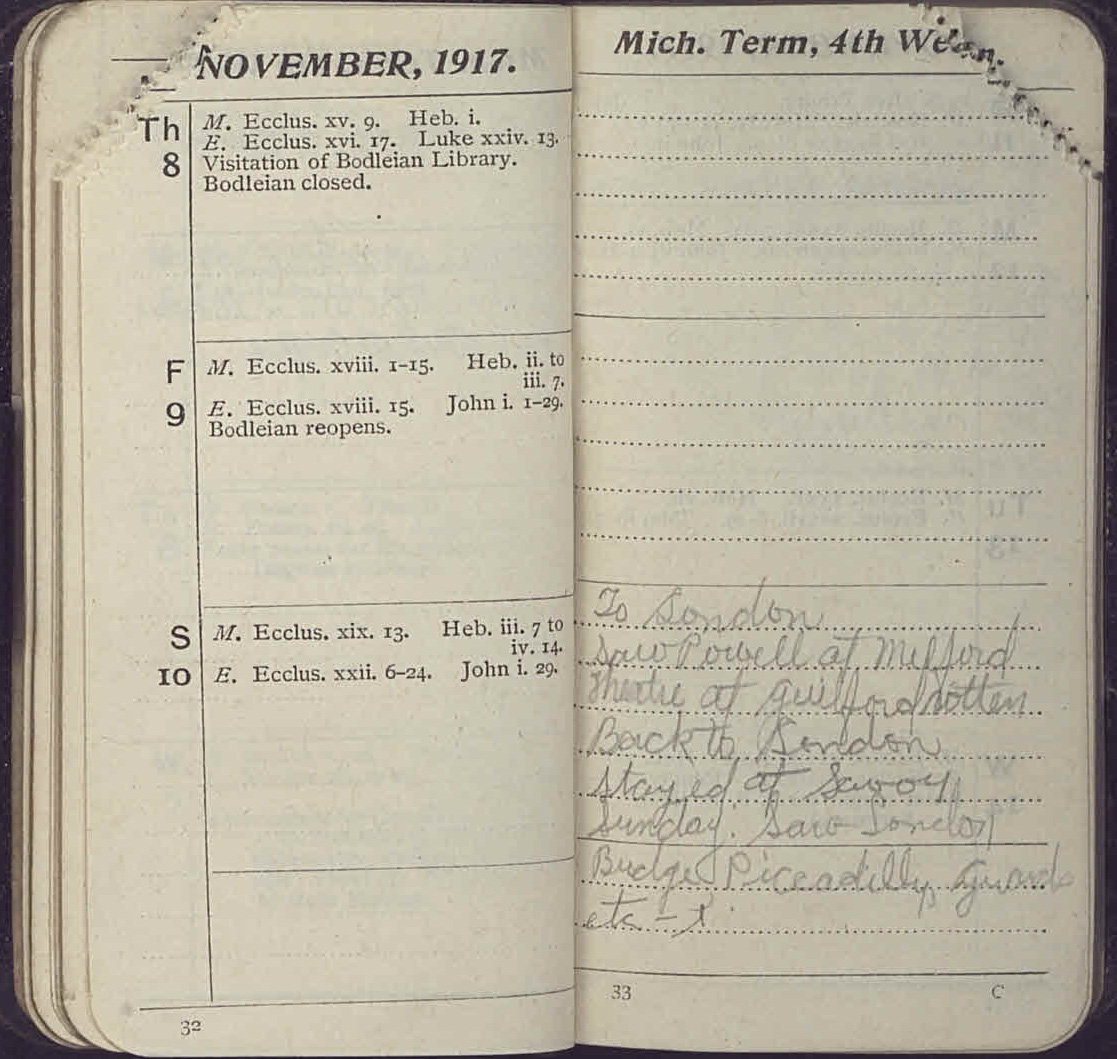
The following Thursday and Friday brought exams on the Vickers gun; Stoughton noted in his pocket diary on Friday that he passed all of them: “Honorable mention 150 out of 160 ‘Very good’.”38 The next day, according to Foss, he, Stoughton, Mc[Carthy] and Spear “went horseback riding.”39 In the meantime, the men at Grantham learned that there were places for fifty of them at training squadrons; Stoughton was not among those selected, but “Hamilton is one of the boys to leave Monday for flying squadrons & I rather envy him.”40 The men who remained at Grantham began their two week course on the Lewis gun.
Some of the men, probably including Stoughton, enjoyed time spent at Christopher Hatton Turnor’s Stoke Rochford Hall, about 4 miles south of Grantham. Stoughton wrote his mother that “I have had some nice times at Beaver Castle which is about 4 miles from here. The Turners [sic] are beautiful people & have used me fine. Been out a couple weekends.”41 As far as I know, none of the men went to Belvoir (pronounced “beaver”) Castle, about four miles west of Grantham, and I suspect that Stoughton slipped in recollecting the name of the Turnors’ place.
Preparations for a grand Thanksgiving celebration were ongoing. Stoughton wrote to his mother as early as November 6, 1917, of the planning for this: “The English officers have a corner on all the turkeys in this part of the ‘island’ and have ten at present. They are scarce birds in England, but with all their influence I guess they can raise as many more.” Thanksgiving morning “Foss and I went to an aerodrome . . . & had a ‘flip’—‘joy ride’. In the afternoon we had a football game and the ‘big’ dinner was at night.”42 Many of the second Oxford detachment men who had been dispersed to squadrons returned to Grantham to join in the festivities; Stoughton also recorded in his pocket diary that a fellow Vermonter, Donald Guy McIvor, M.D., who was on the staff of the Bagthorpe Military Hospital in Nottingham, joined them.
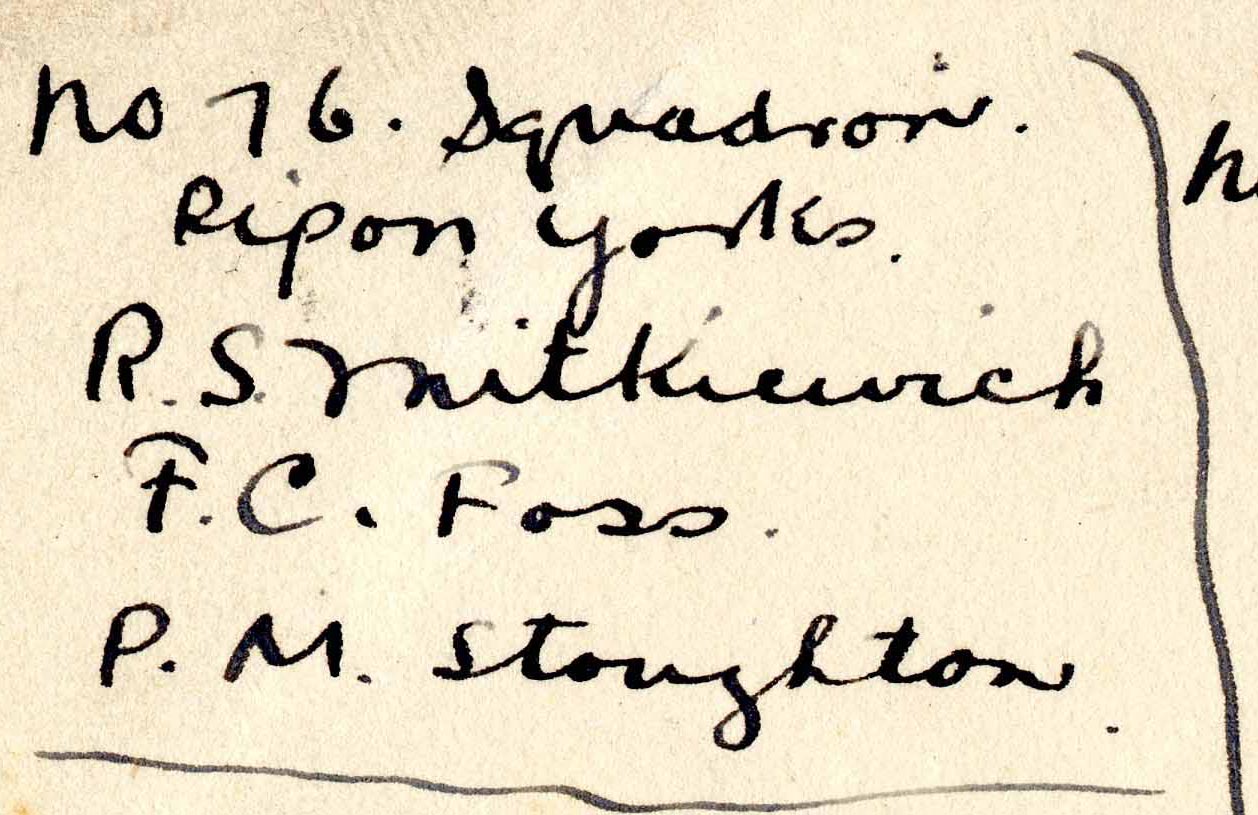
Stoughton learned the next day that he had “Passed all exams with 269 out of 300.”43 There was more cause for celebration when word was received that the men at Grantham would be posted to squadrons on Monday. On Sunday, December 2, 1917, Stoughton reported this good news to his mother: “I am leaving here tomorrow for flying school. There are only three of us Americans going to the place where I am going. Foss, of whom I have written you before and with whom I am very pally, is going with me, and one other fellow [Raphael Sergius De Mitkiewicz]. We are going to . . . number 76 squadron, Ripon, Yorkshire. . . .”
Stoughton and Foss arrived at Ripon in Yorkshire around 5 p.m. on Monday, December 3, 1917; De Mitkiewicz was to follow the next day.44 As Stoughton noted “this is not a regular school but a home defense squadron.”45 No. 76 H.D. Squadron was one of a number of squadrons charged with defending against German airship incursions from the North Sea. No. 76 focussed in particular on potential attacks on the Teeside industrial area.46 With its headquarters at Ripon, No. 76 had detachments in Catterick, Copmathorpe, and nearby Helperby.
The airfield and HQ buildings for No. 76 were located at the Ripon race course southeast of the city. The two newcomers had supper there, and Foss apparently remained the night, while Stoughton went to their billet at the Studley Royal Hotel back in town.47 The next day they met the squadron C.O., Major Eric MacKay Murray, who, the following day drove them in his “gin palace” (limousine) to visit nearby Helperby where B flight was stationed, and where Stoughton and Foss were assigned the next day (December 6, 1918).48 The Americans were cordially welcomed at Helperby by the flight commander, Captain John Overton Cone Orton, who had them to tea at his house that day.49 Orton and Murray had served together in Mesopotamia, where, according to Stoughton’s diary entry, Orton had been Murray’s observer. Orton had qualified as a pilot in the spring of 1917.49a
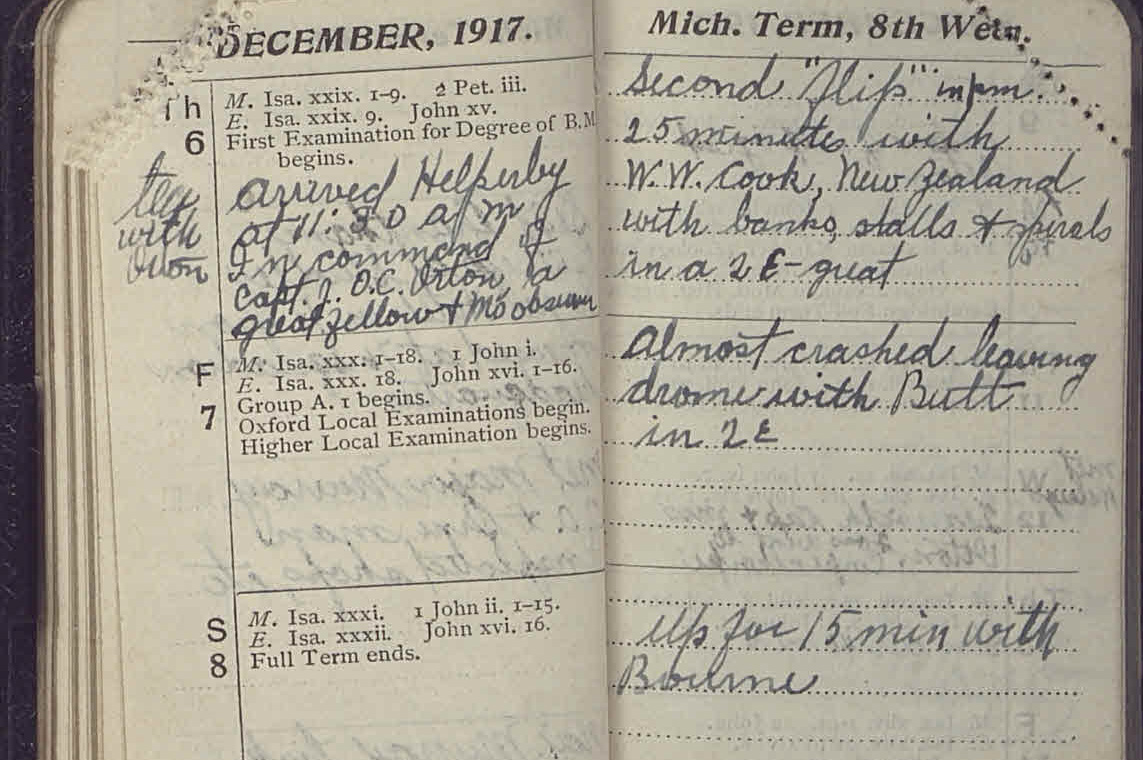
Stoughton’s pilot’s flying log book does not seem to be extant, but, fortunately, he made some notes about his flight training in his pocket diary (1917) and in his loose-leaf notebook diary (1918).50 In the former, he notes that on the day he arrived at Helperby, he had “25 minutes with W[illiam] W[allace] Cook, New Zealand, with banks, stalls & spirals in a [B.E.]2E—great.”51 76 H.D. Squadron was at this time equipped with B.E.12a’s, which, as single seat planes, were not suited for training, and with two-seat B.E.2e’s, some of which evidently had dual controls. Over the next week, Stoughton went up four more times with various 76 Squadron pilots: Frank Wilfred Butt, John Arthur Watson Bourne, Sydney Hill (briefly Stoughton’s roommate), and once again with Cook.52 During a forty-minute flight with the latter on December 13, 1917, they flew to Ripon, and Stoughton noted in his pocket diary that he controlled the plane for ten minutes.
Foss had by now been reassigned to 76’s A flight at Copmanthorpe, so that Stoughton was the only American at Helperby; as such he received a good deal of attention. In particular he was friendly with the Ortons, going to tea with the captain and his wife, and perhaps going into York to see the play “Pomponette,” for which Mrs. Orton’s brother had written the music.53 It was also apparently through the Ortons that Stoughton became acquainted with the Utterson-Kelso family, who generously had him to their home, Brafferton Hall, a number of times, including for the Christmas holidays.54
On New Year’s Eve,
Captain Orton took me up for some dual instruction. By the way he is very well pleased with the way I am doing & attracted my [attention] in the air & when I looked over my shoulder he was clapping his hands in applause. . . . After some little instruction he pointed out a river to follow and in a few minutes a big city came under us (you know I always have the feeling that I am sitting up there with places coming under the machine.) It was York; & after taking a peep down onto the business portion and a peek into a few private gardens (you know that is a source of great amusement—being able to peep into places well shut of [sic] from others by high walls) we landed at the aerodrome where Foss is stationed.55
Foss reports that “Capt. Orton and Stoughton arrived on a 2E about lunch time. Perley sang songs and Orton danced.”56 Stoughton continues: “we hopped off again & landed at another ground. From there we flew home & on the way beat the fastest express on the Great Northern R.R. Great sport. In the evening I had dinner at Mrs. Kelso’s who had some people in to meet me.”57 A few days later, Stoughton dined with Dr. Henry Ingledew Daggett and his family at Ladywell House in Boroughbridge; Stoughton had become acquainted with the family through the son, William Ingledew Daggett.58
Sometime during the first week of January,
we went up from here [Helperby] to do a ‘ceiling’ test, which means to go up as high as the machine can climb. It is the most exhilerating [sic] part of the game I have yet struck. We climbed up to those nice big fleecy clouds . . . & after a few minutes came out on the upper side in beautiful sunlight. On we went until the clouds were thousands of feet below us. . . . After being ‘up stairs’ for a time we came down again & passing through the clouds, struck a pretty little snow storm and, coming out of that, we were just above Duncombe Park. We landed on the lawn in front of the house, which is really a castle, & paid a call. The English officer I was with had been there before. Well, there was a luncheon party at the Manor nearby and when Lady F[eversham] found we were at the Park, nothing would do but we must go over which we did. Met a lot of people—nobility all—& after a most pleasant time, we set off home. Fine trip.59
Stoughton’s social life came to an abrupt halt the second week of January 1918, when he was among those at Helperby—presumably also including his roommate Adrian Clifford de Fleury60— put into a ten day quarantine because of a scarlet fever scare. Fortunately, none of the quarantined became ill, and all were released on January 18, 1918.61 Stoughton “had three invitations out tomorrow from people who want to assist me to break my confinement.”62
On January 26, 1918, Stoughton, along with many others from the second Oxford detachment, was reposted and was one of many sent to Waddington, just south of Lincoln. Foss wrote in his diary that day: “Orders from Ripon to proceed to Waddington on 3:35 train from York. Packed up and reached station with my luggage about 3:20. Stoughton and Mit [De Mitkiewicz] were there all smiles once more we got together.”
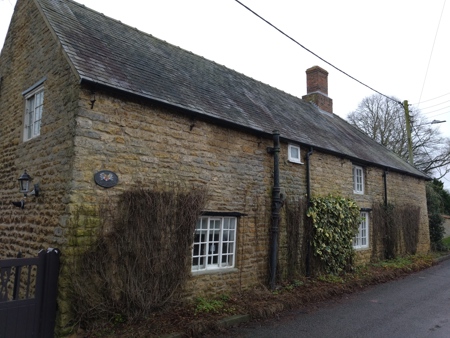
The three arrived at Waddington in the early evening and met several men they knew from the detachment. “While eating, an R.F.C. Hun [pilot in training] from the table to the right behind us was looking for sugar. P.M.S. passed him some and ‘Cheerio’ started a conversation.” This man, “Mr. Hatten,” saw the quarters to which Stoughton and Foss were assigned in the Waddington village hall “and said he might find us a billet. . . . we came to meet his landlord and lady. Mr. and Mrs. Black. Finally we negotiated to take one of her rooms.”63 Writing home two days later, Stoughton told his mother that “I am very comfortably situated. Foss & I have a room at a cozy little farm house (neat as wax) about ½ mile from the drome & we eat at the mess over there. We pay 50 cents a day each but we have tea & toast before we go out in the morning & chocolate before we go to bed. So it is worth it & it was this or a cold bunk in a freezy old village hall.” In a later letter, Stoughton specifies his address as “care of A C Black Top Farm Waddington.”64 This was Albert Charles Black of Top Farm on High Street in Waddington.65
Foss noted in his diary on January 28, 1918, that “We are to go overseas with R.F.C. on DH9’s—bombing.” There could still be many changes between this early stage of training and overseas assignment, but Waddington training squadrons did, indeed, mainly prepare pilots to fly two-seater planes like the DH.9, used for bombing and observation, rather than to fly single seater scouts. Stoughton, a little over a month later, wrote that “From present indications it looks as though I would be in a bombing squadron . . . I rather wanted artillery observation. . . .”66
Stoughton and Foss were initially assigned to No. 44 T.S. at Waddington; they were once again in a holding pattern: “and again we have to start in on a ground school course that is lectures buzzing gunnery etc. . . . this class room work is given us only because there is nothing else for about 40 of us to do.”67
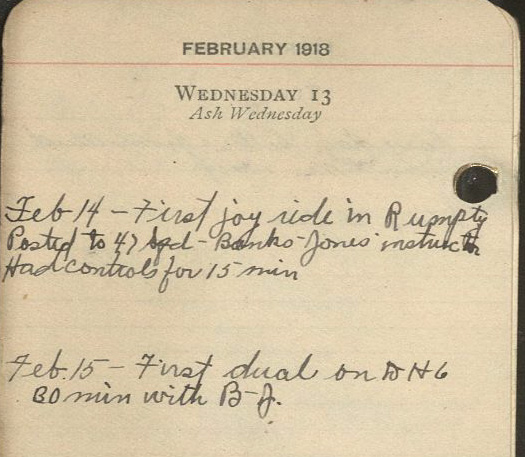
On the last day of January Foss wrote in his diary: “Declared a holiday. Stoughton and I went into Lincoln. Saw Cathedral, old castle, a trial in court house. . . . We bought tea, onions, candy, and salmon for Mrs. Black.” On February 14, 1918, finally, Stoughton, along with Foss and De Mitkiewicz, was posted to No. 47 T.S., also at Waddington.68 That day Stoughton recorded in his loose-leaf diary his “First joy ride in Rumpty . . . [Ralph Myddleton] Banks-Jones instructor [I] Had controls for 15 min.” “Rumpty” was the slang term for the Maurice Farman Shorthorn S11, a “pusher” biplane (i.e., one with the propeller mounted behind the cockpit) that had been developed before the war and used on the Western Front into 1915, and afterwards extensively for training. The next day Stoughton noted his first instructional flight on a DH.6 (the same type he had had a joy ride in at Port Meadow); his instructor was again Bankes-Jones.
Progress now was rapid. On Monday, February 18, 1918, Stoughton flew solo for the first time and made three landings. When he went up again that day, he experienced his first crash, “due to conking engine”; it was fortunately not serious.69 Nothing daunted, he flew a DH.6 solo for fifty-five minutes the following day, according to the note in his (loose-leaf) diary. This was the same day that one of his ground school classmates, Donald Elsworth Carlton, was killed when the R.E.8 he was attempting to fly from Waddington, where he was stationed, to Grantham went into a spin and crashed near Spittlegate. A funeral for Carlton was held in Lincoln on Friday, February 22, 1918, and Stoughton served as a pall bearer.70 It was presumably in connection with this sad occasion that Stoughton took Deetjen to tea in Lincoln.71
Saturday “was a wonderful day & spent 85 minutes in the air in the morning.”72 Stoughton wrote reassuringly to his mother that “It [flying] is great & I like it better than ever. I seemed to get it naturally for I did not require much instruction.”73 In the same letter he notes anticipating “a few days leave soon & I think I will go to Helperby.” The reason for the leave becomes apparent in a letter written March 1, 1918, when he reports to his mother: “Have finished what is called my elementary training and next week begin the next step”; pilots in training typically were given some leave after each major step in their training. In a letter to his father a few days later, Stoughton notes that as part of his elementary training he has “put in about six hours solo in the air. . . . I am now waiting to be posted to the next highest training squadron.”74 He was aware that others were well ahead of him. In the same letter he writes that “The first four commissions for any of our crowd arrived Sunday for four of the fellows who have completed the necessary amount of time to be spent in the air.”75
As it turned out, Stoughton did not use his leave go to Helperby. He and Foss both had leave, and on March 6, 1918,76 “Perley and I [Foss] set out for London each with a check for $93.50 and several pounds. We had a right gay time. Put up at the Savoy. Saw 3 shows: ‘Chu Chin Chow,’ ‘General Post,’ and ‘The Bing Boys on Broadway.’ Had 2 great oyster and lobster dinners.”77 In his (loose-leaf) diary on March 6, 1918, Stoughton records having had dinner at Scott’s, a seafood restaurant in Mayfair. Lunch the next day was at Monico’s, tea at Murray’s Jazz and Cabaret Club, and supper at the Savoy. Stoughton noted that he couldn’t dance at Murray’s as he was in uniform.78 Writing his mother on March 9, 1918, he explained that he and Foss were able to enter the members-only club “through a friend of [Foss], a leading barrister”—this was apparently Brooklyn-born Howard Sawyer Harrington (Foss: “the head of Uncle Charley’s firm”79), senior member of an international law firm with offices in New York and London. In Stoughton’s diary entry for March 7, 1918, he also writes “Met Porter”; it may be that his fellow second Oxford detachment member Robert Brewster Porter—who later flew with the 11th Aero—was at this time in London.
Stoughton noted in a letter to his mother on March 11, 1918, that he “Did not fly any last week & probably won’t this week for I’m waiting still to start higher training.” In many cases higher training entailed a relocation, but Waddington had both elementary and higher training squadrons, so Stoughton anticipated that he would “remain at the same address.”80 At what point Stoughton technically began his higher training is unclear, but on March 28, 1918, he wrote his mother: “Have done almost no flying in the squadron I am now in for various reasons. Instructor has been ill & everything is overcrowded so I am not anywhere near finished.” Foss, as well as Dana Edmund Coates, both at No. 47 T.S., record many flights in their pilot’s flying log books in March; both were in B flight; presumably Stoughton was either at 47 but in a different flight or in a different training squadron. In late April 1918, Stoughton mentions his squadron commander, Captain [Arthur Schuldham] Redfern, who was at this time C.O. of No. 48 T.S. at Waddington; it may be that Stoughton had been posted to No. 48 sometime in March.
Meanwhile, on April 4, 1918, Stoughton and Foss “moved into camp from Black’s. Foss and I have one of the best rooms in hut opposite Mess door and on tennis court.”81 “Everyone had to [move into camp] and I hung off just as long as possible. Many officers have had to go under canvass which is not too pleasant at this time of year over here.”82 He and Foss took it as a challenge to avoid a tent and “by great wiggling we not only got into a hut but persuaded a couple of fellows to double up so we have one of the very best rooms to ourselves.”83
The next day, April 5, 1918, Stoughton wrote in his diary “Took DH6 [C]2016 from Waddington at 5:50 PM. Landed at Howden at 7. Royally entertained.”84 It appears that Stoughton had been given permission or ordered to ferry this DH.6 to another aerodrome, and Howden, a naval airship station about forty miles north of Waddington, was on the way. The weather being very bad, Stoughton stayed over at Howden until the seventh; he took the opportunity to visit nearby Leeds the afternoon and evening of the sixth. He took off again the morning of April 7, 1918, bound for Helperby, making interim stops at Burnholme (York) and Copmanthorpe. The weather was still poor, and he notes having passed through a hail storm. His arrival at Helperby at 3 in the afternoon gave him time to go to Brafferton Hall “to Kelsoe’s [sic] for tea & they hunted up more girls and we had a little tea dance even though it was Sunday. . . . They rather like our style of dancing.”85 Later, at the mess at No. 76 T.S., Stoughton caught up with his friends from the squadron over dinner there before spending the evening with the Daggetts, and then back to 76.
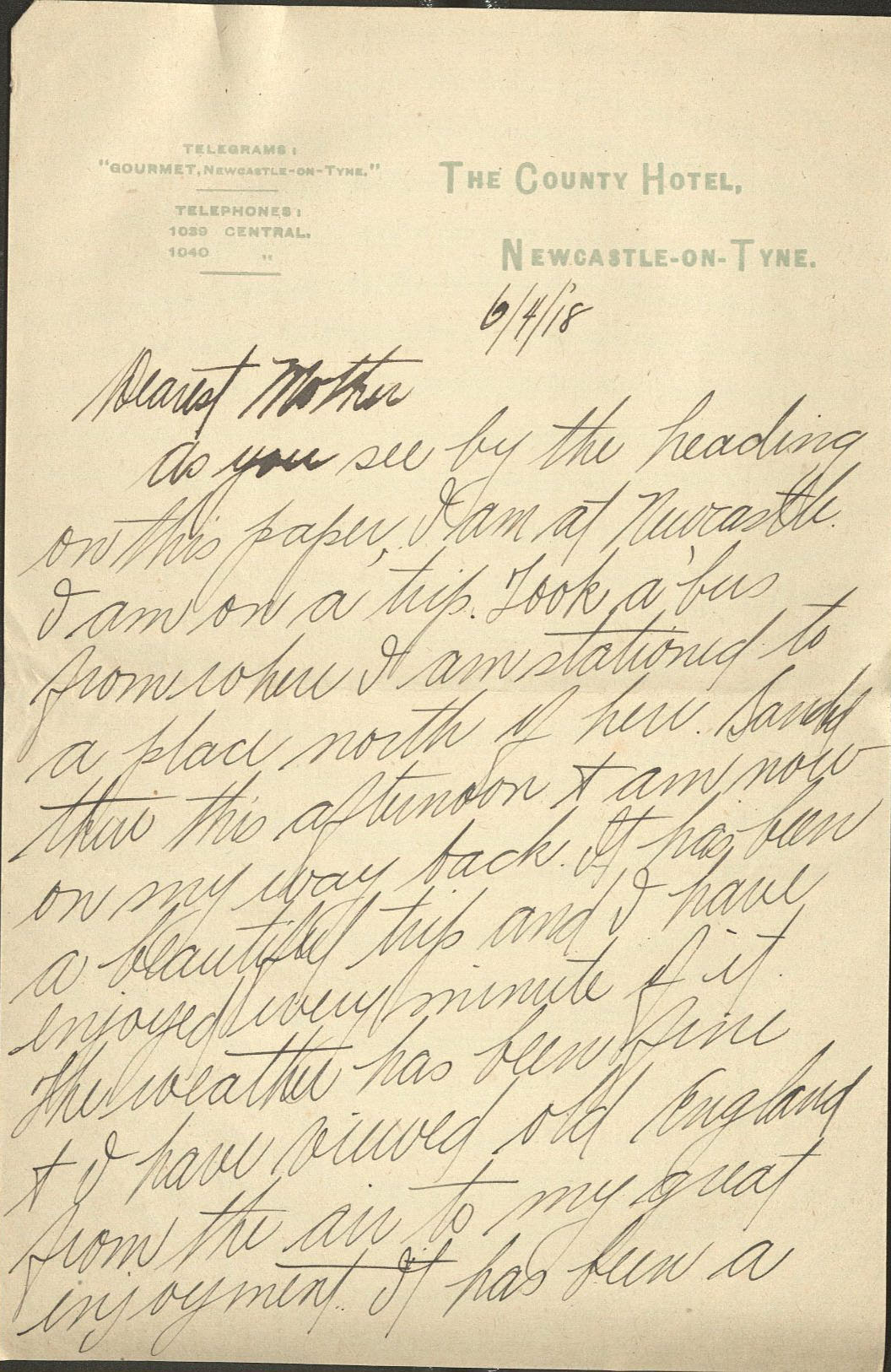
Having taken off from Helperby at 10:30 the next morning (April 8, 1918), Stoughton was forced to land at Kirklington, just ten miles to the northwest, “because cowling blew off.” “Rushed telegrams to Helperby & to Pitts who was with me & who continued on to Catterick. First selectman & general boss about town came to my assistance. Village blacksmith repaired cowling & took off at 12:05 arrived at Catterick at 12:25.”86 Stoughton stayed at Catterick for lunch and then took off again at 3:45, now accompanied by “two English fellows from 51.”Stoughton “arrived at Cramlington about 5:30 & delivered buss.”88 In a letter written to his mother after the trip, Stoughton notes that he and his fellow pilots had arrived at Cramlington “just in time for tea. Well the major in charge is one good sport and when he found he could not keep us for dinner or over night he ordered out his own limousine & took us back to [Newcastle]. After a dinner, show etc. we turned in & the next day (Tuesday) came back here [Waddington] by train. Some trip and I hope it happens often.”89 In his diary entry for April 9, 1918, Stoughton notes “King & Queen were at Lincoln station when we arrived and had fine view of them.”
The ferrying of a DH.6, a plane designed for training purposes, from one aerodrome to another by a relatively inexperienced pilot seems odd. However, it is evident from other sources that Stoughton was regarded as a promising pilot, and it turns out that Cramlington, just north of Newcastle, hosted training squadrons that used DH.6s and also “played a major early part in developing anti-submarine patrol operations with Airco DH6 biplanes formerly used as trainers.”90 The latter development was still in the future when Stoughton arrived with C2016, but perhaps his delivery was part of preparations already underway. As neither Stoughton’s pilot’s flying log book nor his R.F.C. training transfer card appears to be extant, it is not evident whether the ferrying trip counted towards twenty hours of solo flying (required for a commission and for R.A.F. graduation) or as fulfilling the cross country flight requirement needed for R.A.F. graduation. That Stoughton was struggling to fulfill the former (see below) suggests not.
U.S. commission, R.A.F. graduation
In early April, both Foss and Coates recorded having flown the twenty hours solo requisite for being recommended for a commission. Stoughton, however, lagged behind. Writing to his mother on April 15, 1918, about his prospects of receiving his commission, he remarked that “I should be able to get in 20 hours this month and be recommended . . . .” Receiving a commission was a matter of pride, but it also had financial consequences; Stoughton was anxious to be able to help support his parents, and the issue of his pay is a frequent topic in his letters.
Stoughton would have been surprised to know that he had already been recommended for his commission on April 8, 1918. In the early spring of 1918 General Pershing had been made aware that many cadets in Europe were unhappy that they had not yet been made first lieutenants. In a cablegram to Washington dated March 13, 1918, Pershing described the situation of the approximately 1400 aviation cadets in Europe, some of whom had waited three months to start flying training, and some of whom, after five months, were still waiting and might have to wait another four. “All of those cadets would have been commissioned prior to this date if training facilities could have been provided. These conditions have produced profound discouragement among cadets.” To remedy this injustice, and to put the European cadets on an equal footing with their counterparts in the U.S., Pershing asked permission “to immediately issue to all cadets now in Europe temporary or Reserve commissions in Aviation Section Signal Corps. . . .” Washington approved the plan in a cablegram dated March 21, 1918, but stipulated that the commissioned men be “put on non-flying status. Upon satisfactory completion of flying training they can be transferred as flying officers.”
Thus it was that Pershing, in a cable dated April 8, 1918, recommended that Stoughton, along with Foss and many others, including nearly forty other second Oxford detachment members, be commissioned “First Lieutenants Aviation Reserve,” albeit “non flying.” Washington took its time responding. On April 30, 1918, Pershing wrote: “Request action taken on . . .” and lists cablegrams dated March 29 through April 8, 1918. The cablegram from Washington approving, finally, the April 8, 1918, appointments is dated May 13, 1918.91
Stoughton, meanwhile, by late April 1918, was inching towards his twenty hours. On the 28th he wrote that he had purchased his wings in anticipation of being commissioned; he now had eighteen hours solo under his belt, in part by dint of getting up early to seize flying opportunities. “Have not had very good luck in one way [for I] have not had an instructor & have only been taken up occasionally by the squadron commander Captain Redfern.”92 But on May 2, 1918, he completed the twenty hours and was recommended for his commission through the normal channels (as opposed to Pershing’s special pleading).93 The May 13, 1918, cablegram from Washington meant he did not have to wait for normal channels for approval, and the “non-flying” status did not now apply to him. Overseas communications and paperwork being what they were, it was still some time before the news reached Stoughton. On May 24, 1918 (Friday), he wrote his mother that “the best news we have had in some time is that our commissions as 1st lieuts have come through to London from Washington & we should have them by tomorrow or Monday at the latest. This means that I will also be entitled to wear my wings. I earned that right some time ago. For I have graduated in flying & am, I suppose, what is called ‘a pilot’.”
Stoughton continued this letter over the next days in order to be able to report his commission actually having come through to Waddington. He goes on: “but as yet I have not received my active service orders. They are the orders which allow me to put up my insignia, Sam Brown [sic] belt, wings, etc.” Continuing the letter the next day: “While I was writing yesterday my active service orders came through.” In a letter of June 9, 1918, in connection with a discussion of his pay, he provides the date: “. . . did not get active services orders ’til the 27th.”
As will be apparent by now, Americans training with the R.F.C. (the Royal Air Force as of April 1, 1918) were on two parallel tracks of progress. They needed twenty hours solo flying to be commissioned by the U.S.; to “graduate” in the R.F.C. / R.A.F. they also needed twenty hours solo, but also had to pass various tests: flying cross-country, flying at high altitude, putting in time on a service (as opposed to a training) plane. Thus, when in his May 24, 1918, letter Stoughton remarks that “I earned that right [to wear wings] some time ago. For I have graduated in flying,” he is presumably referring to his progress in the R.A.F. He notes that “I have been putting in some time in the air & now have about fourty [sic] hours [dual and solo] to my credit. Of course this isn’t so very much but fifteen of it has been spent on a service buss, one used over there.” It is likely that he is here referring to the DH.4 or the DH.9. Assuming his training resembled that of Foss, Stoughton probably also put in some hours on an R.E.8s and an Armstrong Whitworth FK.8; a diary entry for May 1, 1918, records a solo flight on an “AW (small),” i.e., an Armstrong Whitworth FK.3. In his letter of May 3, 1918, continued the next day, he notes that Redfern, now his instructor, took him up “in a fine little ’buss that I have just gone solo on”; the solo flight may have been his required solo flight on a service machine. Stoughton goes on to mention taking instruction on yet “another [plane] preparatory to going solo on it.”
Progress on the U.S. track brought better pay; graduation in the R.A.F. track brought graduation leave. Foss graduated on April 23, 1918, and it appears that he put off using his leave until Stoughton had also graduated, which would have happened soon after he fulfilled the twenty-hour solo flying requirement on May 2, 1918.94 In his letter of May 11, 1918 (misdated April 11, 1918), Stoughton describes how he and Foss set out for Scotland on Wednesday, May 8, 1918, and spent time in Glasgow, visited Loch Lomond, and went on to Edinburgh before taking the train to arrive back in Waddington on Saturday the 11th. In his May 3, 1918, letter, Stoughton had described plans to arrange simultaneous leave with an English friend and Foss in order to spend time at the friend’s bungalow at Leigh-by-the-Sea [sic; sc. Leigh on Sea?]; presumably this plan was superseded by the notion of going to Scotland (unless they did both, in which case either Stoughton did not write home about the trip to Leigh or the relevant letter is not extant).
Stoughton remarked in his letter of May 24, 1918, that he knew he still had “at least another six weeks ahead of me. And it is all pleasure now. I am past the classes & only fly. I do enjoy it, I can tell you & get better at the game every day.” He also noted that he had “another training squadron to go through.” Foss at the end of May transferred to Waddington’s No. 44 Training Squadron (which seems to have served both as a pool squadron and as a higher training squadron), and it may be that Stoughton was also transferred to 44.95 In any case, Foss’s pilot’s flying log book shows that he began piling on the hours on DH.9s, and Stoughton will have done the same. As well as flying for training purposes, Stoughton made more than one pleasure trip to visit Orton and his family, now at Retford, where Orton had been appointed commander of No. 199 Night Training Squadron.96
Towards the end of May 1918 Stoughton became good friends with Thomas Henry Wright, who was also at Waddington. Through Wright Stoughton met Frank William Gilbert and his wife Gertrude and their family, who lived in Chellaston on the southern outskirts of Derby. The father was a wealthy and influential farmer, and his wife evidently very hospitable and motherly.97 Stoughton and Wright made several visits to The Manor House, the Gilberts’ home.
Marske; No. 117 Squadron R.A.F.
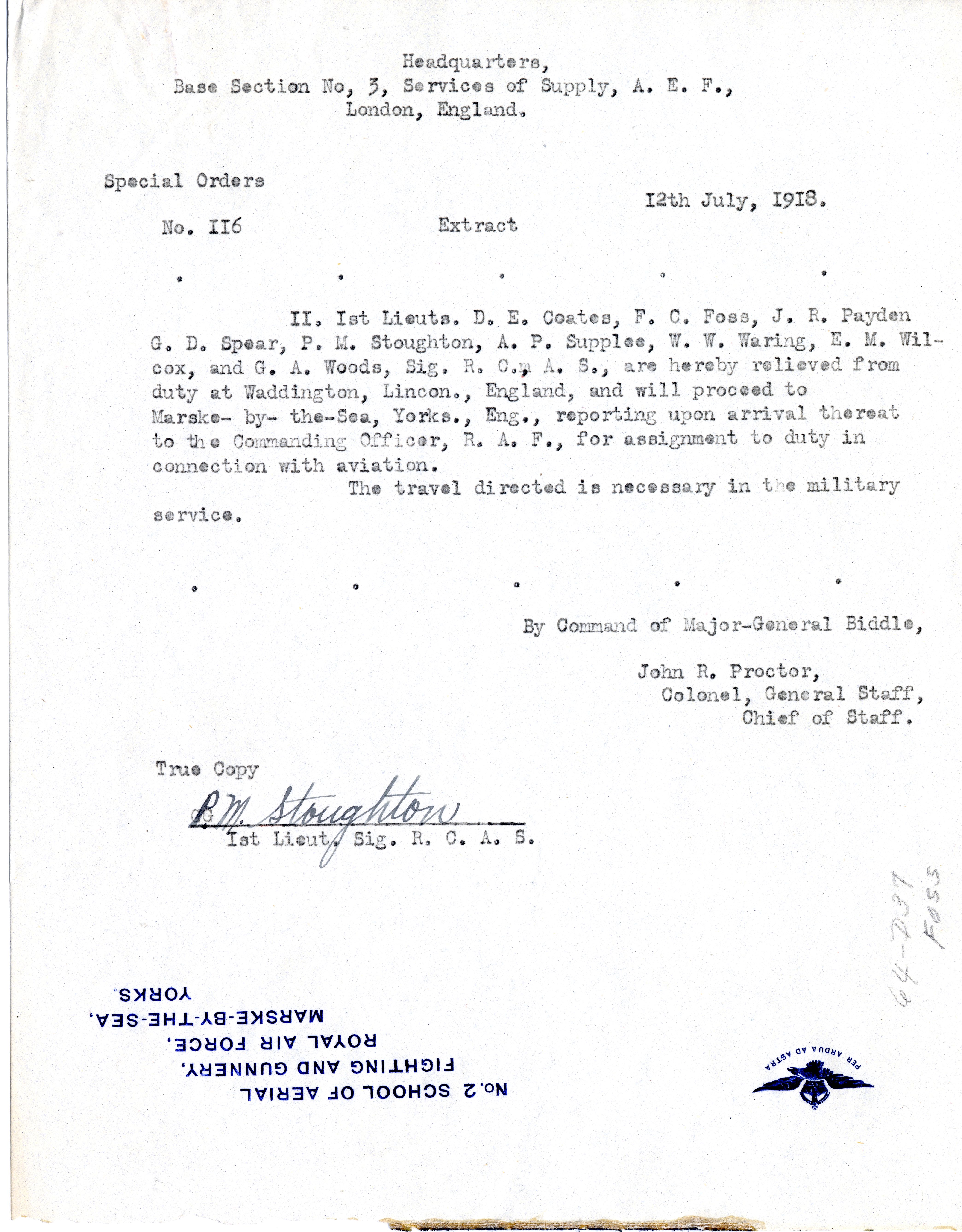
After five long months at Waddington, Stoughton was posted to the No. 2 School of Aerial Fighting and Gunnery at Marske-by-the-Sea in Yorkshire. It appears he arrived there slightly ahead of schedule. His first letter from Marske is dated July 11, 1918, while the orders for himself, Foss, and seven others is dated the next day.98 Foss followed shortly; Stoughton is enthusiastic about their being able to swim in the bracing North Sea.99 He writes nothing about his training at Marske. Assuming, however, that his training was like Foss’s, he would have spent about two weeks in ground classes, and then the last days of July doing mainly firing practice, mostly in DH.9s, but perhaps also DH.4s. Stoughton does write a good deal in enthusiastic anticipation of joining No. 117 Squadron, a newly formed R.A.F. squadron under the leadership of Redfern, who had been his C.O. and instructor at No. 48 T.S. “[Redfern] chose me because he was of the opinion that I was a good pilot. So, you see, besides knowing that I am getting in with a bunch of crack pilots who have had experience over there I also feel good that I was good enough in my line to be picked especially from out of the large number at the aerodrome where I was.”100
Stoughton’s reputation as a “good pilot” went beyond Redfern. In a letter written sometime in August 1918 describing a period of leave spent in London, Hamilton, now with the U.S. 17th Aero, mentions that “I had heard a lot about Perley Stoughton before coming to England and on arriving there found that he had turned out to be one of the best pilots for bombers . . . that the Americans have.”101
The date of Stoughton’s assignment to No. 117 in Norwich in Norfolk is not recorded, but a letter that he wrote on August 2, 1918, makes it clear that he, along with his friend, Wright, is well settled in (Foss had been assigned to the No. 1 School of Navigation and Bomb Dropping at Stonehenge; Stoughton hoped to be able to pull strings to get Foss into No. 117). When Stoughton wrote this early August letter, he and Wright had just returned from ferrying planes to, apparently, Thetford, their second such trip.102 Stoughton notes that he and Wright had just received letters from Mrs. Gilbert and anticipates that he, along with Wright and Wright’s sister, Doris Annie Wright, will visit the Gilberts before long.
The August 2, 1918, letter is, unfortunately, the only (extant) one that Stoughton wrote from Norwich. His next letter is written to his brother Carl on September 12, 1918, telling him he is on his way to France to join an American squadron. And there are two letters written the next day to his mother and his sister May. All three letters were written as he travelled to London. Stoughton expresses regret at having to leave No. 117 and his friends there so suddenly and worries that he may get stuck in yet another training course once he is in France. Stoughton also wrote a letter, apparently not extant, from London, on stationery from the Washington Inn, the American Officers’ Club created by the Y.M.C.A. (there were several buildings used for the Inn, and Stoughton’s letter was from the one in St. James’s Square). According to the account of the letter in Burlington’s Free Press, Stoughton encountered Adrian [sic] Foss at the Inn.103 That he did, indeed, see Foss in London is confirmed by a later letter in which he recounts having received, while in London, his Aunt Nan’s wedding cake and eating it in a taxi with Foss.104
On the sixteenth of September 1918 Stoughton arrived in Havre; the next day he was in Paris. Two days later he was evidently at some kind of holding camp, probably the 1st Air Depot at Colombey-les-Belles aerodrome, still not knowing what American squadron he would be assigned to.105 On September 23, 1918, he writes that he expects to report to the 166th Aero Squadron the next day—he ended up having to wait a further day for his baggage to catch up with him—and notes that “[I] will fly one of the very best & fastest busses the allies have.” The 166th was equipped with DH-4s, the American built version of the British DH.4. Much of Stoughton’s advanced training had almost certainly been on DH.9s, but as the DH.9 was based on the DH.4 it would not have been a stretch for him to be comfortable with the D.H.-4, as is confirmed by a later remark: “The machine & engine I came to fly were both brand new to me but I have mastered them with little difficulty.”106 The engine was the American built Liberty engine, rather than the smaller and less powerful B.H.P engine used in many DH.9s.107
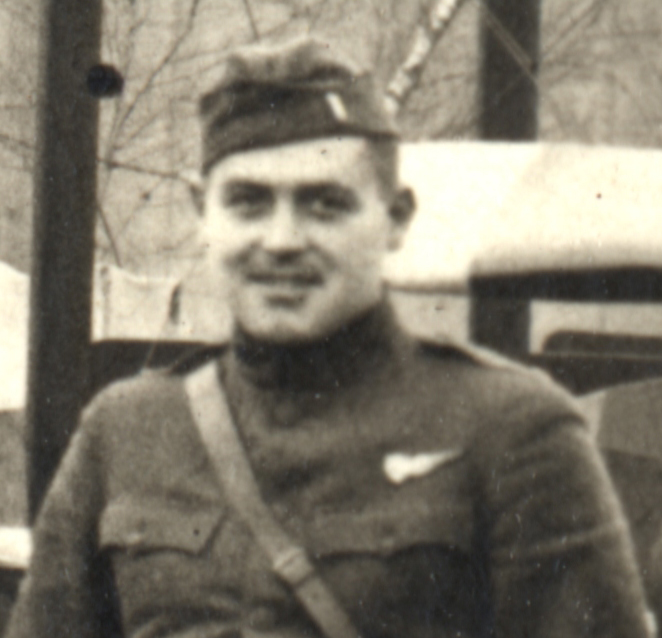
On September 27, 1918, just over a year after his departure from the U.S., Stoughton writes from the aerodrome where the 166th is stationed; the squadron history indicates he reported there on September 25, 1918.108 Fellow second Oxford detachment members Weaver and John Joseph Devery, Jr. were already there; Paul Vincent Carpenter reported the same day, and Harrison Barbour Irwin the next. They were followed in October by Foss, Linn Daicy Merrill, and Phillips Merrill Payson.109
The 166th Aero Squadron had gotten off to a confused and confusing start. For a time it was expected to do salvage and repair work as an Air Park Squadron, but DH-4s appeared, marking it as a bombardment squadron. Then a new C.O. showed up with the expectation that 166 would be an observation squadron (and the DH-4s promptly went to other squadrons). The men (at this point almost exclusively ground crew) betook themselves to Colombey-les-Belles around the beginning of September and awaited developments. Towards the middle of the month, it was once again decided that the 166th was to be a bombing squadron.110
When Stoughton and Carpenter reported, the squadron had just that morning moved about thirty miles west northwest from Colombey-les-Belles to Maulan aerodrome in order to join the 1st Day Bombardment Group.111 The Meuse-Argonne offensive, to which squadrons of the 1st Day Bombardment Group were dedicated, began the next day (September 26, 1918). The 166th Aero, however, needed time to settle in and do practice sorties, and they did not participate in the bombing raids undertaken in late September and the first half of October by the 11th, 20th, and 96th Aero Squadrons, the three other squadrons in the 1st Day Bombardment Group.
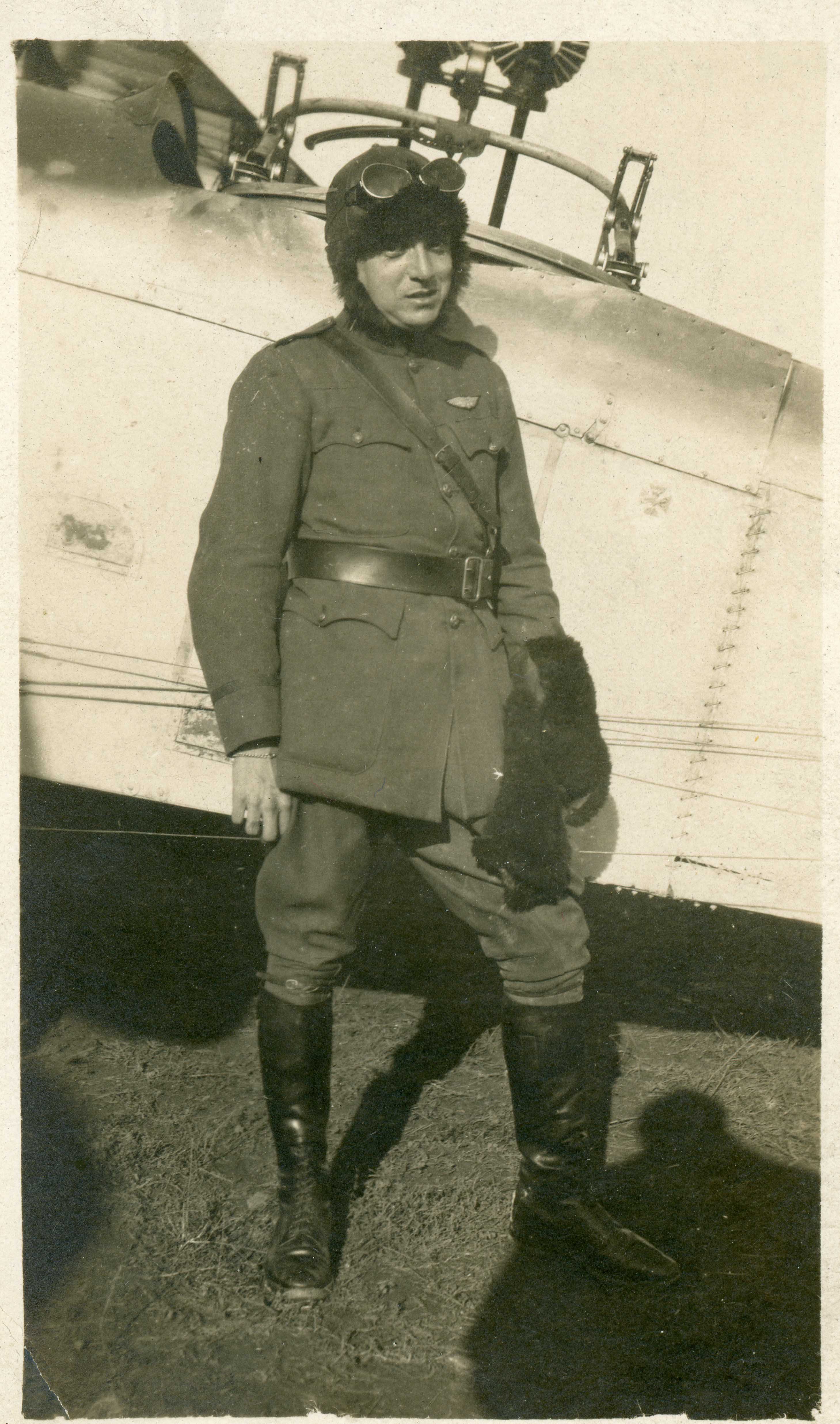
Thus, in his letter of September 27, 1918, Stoughton writes that the day was “an uneventful one.” He goes on: “Rained about all the time,” and this had been and would be an ongoing issue for those on this front that autumn. “. . . all I did was to go over to the sheds & look over some new busses with a view to picking my own. Found a corker & will test it tomorrow if it is fine weather to see if it is as fine as recommended.” There is no indication which DH-4 this was, nor what distinguished it; Stoughton is recorded as having flown three different planes in October and November. Nevertheless, on the thirtieth he reports to his sister that “I have my own machine.”112
At Maulan Stoughton and Carpenter managed to get a room together in a hut. They were fortunate and knew it, for “Arrangements for occupation of Maulan were poorly handled,” and some officers and men ended up sleeping in hangars.113 Stoughton put time and energy into making the hut comfortable, managing to knock out a wall to expand beyond the initial six by eight feet. He was also able to secure and install a stove, ensuring that the room would be popular as a gathering place. As Stoughton tells it, Carpenter was not much help with all this but appreciative of the resulting comfort.114 It is possible that among those who crowded around the stove were other members of the second Oxford detachment, as a number of them had been assigned to the 11th Aero, including, for example, Vincent Paul Oatis, Porter, and Stahl.
The afternoon of October 1, 1918, Stoughton saw the front from the air for the first time. “Was not on a show but we were doing a little practice formation & our leader took us towards the lines so we could get a peek. As a matter of fact we were up so high (about 14,000 ft) & there were so many clouds below us that there wasn’t much to see.”115 He continued flying daily when weather permitted, and made trips up to but not over the lines.116 On October 9, 1918, Foss joined the squadron, and he became Stoughton and Carpenter’s roommate.
Bad weather set in after October 10, 1918. On the fourteenth Stoughton wrote that for this reason “there has been no flying. But I have been on the alert & will get busy as soon as the weather clears.” Two days later, “it is raining there is a low mist and mud up to one’s knees.” Whiling away the time, Stoughton and his two roommates, now joined by Irwin, walked to a village about eight miles away and, eventually, procured a good meal; Stoughton notes that his French is proving adequate.117
The first raid in which the 166th participated took place on October 18, 1918, when the weather finally cleared somewhat. A total of fifty-two planes—each of the four 1st Day Bombardment squadrons contributing a formation of ten to sixteen planes each—set off shortly after 2:00 p.m. to bomb Bayonville (approximately fifty miles to the north of Maulan). A number of planes failed to keep up for various reasons, but the majority reached the target around 3:30. The formations from the 11th, 20th, and 96th bombed Bayonville; apparently by the time the 166th reached this objective clouds hindered visibility, and they flew slightly farther north and west to target nearby Buzancy instead.118
On the twentieth Stoughton wrote an account of the raid to his brother Carl (indicating that the letter could be shared with their sister May and, “if you think it wise,” their mother). As far as Stoughton was concerned, his part in the mission got off to a poor start “when a strange observer [Henry Irving Jenks] came up to me & said he was going over with me because my observer [Edward Lee Brown] had not returned from a 24 hours’ leave.” Though he had not been over the lines with Brown, Stoughton had developed a good deal of confidence in Brown’s skills during their practice flights, but knew nothing of Jenks.
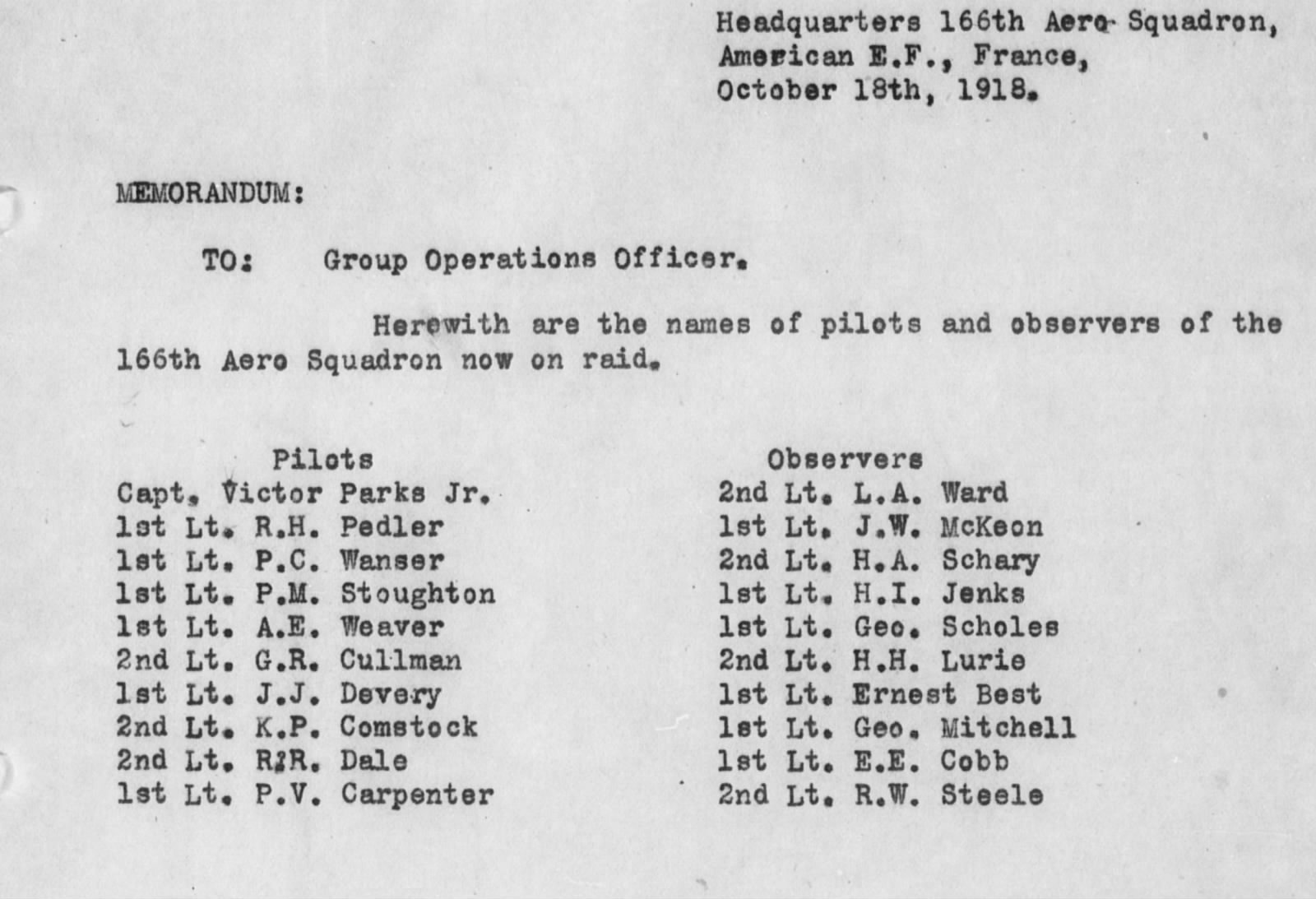
In any case, “We took off the drome and I was near the front.” A memorandum listing the ten teams (but not the plane numbers) on this raid indicates that the lead plane was flown by the squadron commander, Victor Parks, Jr., followed by pilots Russell Henry Pedler and Paul Charles Wanser, and then Stoughton.119
They flew via Souilly and Montfalcon. As they crossed the lines, probably more or less between Landres-et-St.-Georges and Bantheville heading towards the Bois-de-Barricourt, and thus not far from the objective,120
my buss careened like a boat when a heavy wave picks up the stern. I quickly corrected for it but could not immediately focus on the cause. But I was not in the dark long for the same second there was a puff of black smoke just below my left wing and I realized right readily that this was “archie” thrown up by enemy anti aircraft gunners who surely were shooting accurately. But we plodded on to our objective and were just letting our bombs off the machines when we were attacked. And believe me if we were in close formation before we sure cuddled up right then. The buss in front of me went down, but I saw it was in control. Of course I closed up and our work having been completed, our leader opened up & started for home and believe me you couldn’t see our tails for the dust we hurried so. The Hun stuck around & two more machines went down, but both were under control. As soon as we reached their lines they turned back and we sailed back arriving two hours from the time we left.121
Stoughton’s mechanics welcomed him back heartily and went over the plane. They found “three holes made by machine gun bullets and a hole under my left wing made by a piece of shrapnel when I saw the black smoke. Those holes have been mended now and a little iron cross painted in black on each one of them. . . .” To his disgust, Stoughton found that Jenks had not dropped any bombs, although he “did manage to keep his guns busy.”122
There appear to be no letters written by Stoughton between October 20 and November 8, 1918 extant, but squadron and 1st Day Bombardment Group records provide information on his flying activities. Poor weather after the eighteenth meant no more missions were flown until October 22, 1918, when the 96th Aero and the 166th attempted a joint raid but turned back when visibility proved too poor to proceed. Stoughton in DH-4 32613 with observer Brown was assigned to this aborted mission, as were fellow second Oxford detachment members Carpenter, Devery, Foss, Irwin, Merrill, Payson, and Weaver.123
On October 23, 1918, there was a morning mission using formations from the 11th and 20th Aero Squadrons. In the afternoon a second mission involved all four squadrons. Stoughton in DH-4 32613 and his observer Brown were among the thirteen teams from the 166th. About half the planes from the 166th actually reached their objective and at 3:30 p.m. dropped 550 kilograms of bombs on the Bois de Barricourt. There they encountered not only “active and accurate” anti-aircraft fire, but also a formation of Fokkers, and the results of their dropped bombs were “unobserved on account of combat.” “During the course of the combat three of our [166th’s] planes were forced to land. They landed in control within our own lines.” Whether Stoughton and Brown were among the teams that reached the objective is not recorded. It is, however, known that both of Stoughton’s friends, Foss and Carpenter, had to make forced landings.124
Bad weather once again set in, so that the next mission did not take place until the afternoon of October 27, 1918, when, despite poor visibility, all four squadrons of the 1st Day Bombardment Group took off at about 2:00 p.m. to bomb Briquenay, slightly to the west of the previous objectives. There were fifteen teams from the 166th, including Stoughton, now flying DH-4 32949, with observer Harry Dawson Hotaling. Some planes, including Stoughton’s, did not reach the objective, and Stoughton was one of two pilots who were forced to land, fortunately within Allied lines.125
Bad weather meant no missions the next day, but raids were conducted on October 29, 30, and 31, 1918, and Stoughton took part in four of the five raids flown on these days by the 166th . On October 29, 1918, he did not take part in the morning raid undertaken solely by the 166th. In the afternoon, however, as part of a combined mission of the four 1st Day Bombardment Group squadrons, Stoughton and Hotaling in DH-4 32949 were among the ten teams from 166 that set off at 2:00 p.m. to bomb Damvillers, a town about six miles east of the Meuse (previous targets had been to the west of the river). Their path took them initially north-northeast thirty miles via Bar-le-Duc to Clermont where, flying at 12,000 feet, they turned east northeast to cross the Meuse near Gercourt. All but one plane (Foss’s) reached Damvillers, dropped their bombs at 3:15, and were back at Maulan at 4:00 p.m.126
The next day Stoughton took part in both the morning and the afternoon raids. He was back with observer Brown, still flying DH-4 32949. Stoughton was one of two pilots (the other was Foss) who were unable to reach the objective of the morning raid, but in the afternoon his plane was one of ten that reached Belleville-sur-Bar, a target farther north and west than any of the previous objectives. They were attacked by enemy planes, but with apparently no ill consequences. Despite “poor visibility,” it was possible to observe “Belleville in flames.”127
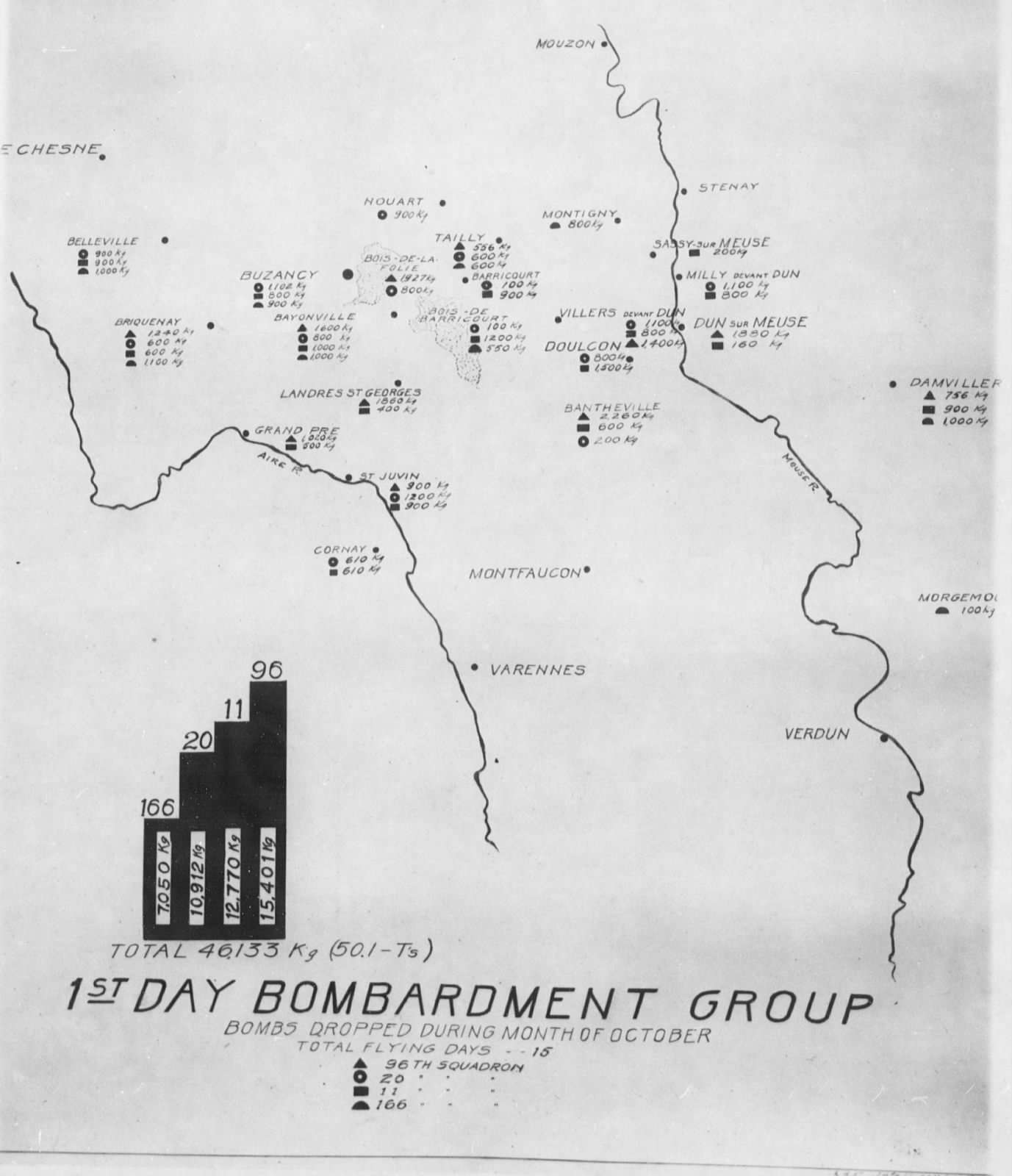
Stoughton with Brown, back in DH-4 32613, was among those who were not able to reach the objective in the next day’s early morning mission, which targeted Tailly, now only a few miles beyond advancing American lines.128
No missions were flown the first two days of November. On November 3, 1918, Stoughton, flying DH-4 32885 and with an observer new to him, Ellis Corey Balsinger, took off at 8:25 as part of a ten-plane formation of the 166th, which was in turn part of a four-squadron mission tasked with bombing Stenay and Martincourt-sur-Meuse, the most distant objectives yet. Three planes from the 166th did not reach the objective, including 32885 which, according to an account of the mission, crashed.129 This was Stoughton’s final mission.
There is now another gap in (extant) letters written by Stoughton. There is silence after his letter of October 20, 1918, to his brother, until November 8, 1918, when he writes to his mother, and then again on the thirteenth. In neither of these does Stoughton allude to his crash but rather, on the eighth, writes that “things run along in camp at the front much the same week in & week out. Fremont, Carpenter & I are very cozy in our room which is as good as any. . . .” In fact, Carpenter, much shaken by his forced landing on October 23, 1918, had left camp and arrived at the Château-de-Cirey to recuperate the day of Stoughton’s crash.130 Stoughton not infrequently misdated his letters, but internal evidence—his allusions to the progress of the war and to his friend Wright’s pending court martial—suggest that this is not the case here.131 In his letter of November 13, 1918, he writes mostly about the Armistice and the possibility of being part of the Army of Occupation.
Two days later, on November 15, 1918, finally, Stoughton writes to his mother, “now that it [the war] is all over I’ll tell you that for the past 12 days I have been in hospital. I crashed taking off one morning starting on a raid. The only injury was a bump on the nose. My face was a picture for Puck. But luckily did not break the bone & now I am as handsome as ever. It wasn’t necessary to send me to the hospital but they wanted to be on the safe side.” As far as I can tell, Stoughton’s name did not appear in the official casualty lists. However, Stoughton or someone close to him evidently wrote a more detailed account of his forced landing which made its way to the Burlington Free Press, which reported that
Word has been received in the city that First Lieutenant Perley M. Stoughton . . . was the victim of an accident in France. . . . He was on his way to the scene of a battle when his engine stopped. . . . He was compelled to make a landing as soon as possible and headed for his own airdrome which was not far behind. He was not able, however [to] make the entire distance and his machine smashed into a rocky ravine. His observer got off without a scratch but Lieutenant Stoughton received some bad cuts on his face and a bump in the eye that closed it. He was carried in an ambulance to the airdrome but soon developed symptoms that indicated he might be internally injured and he was rushed to a base hospital. Late information is that he is coming out of his accident all right.132
In a letter Stoughton wrote to his brother Carl on January 12, 1919, he mentions rather casually that he has now “already gained most of the thirty-five pounds I lost,” which certainly suggests having had challenging injuries to recover from.
After his letter of November 15, 1918, there is another gap in Stoughton’s extant letters until one written to his mother from Château Thierry on December 20, 1918. He records his extreme disappointment that his efforts to get home by Christmas have come to naught. Given that, he is now determined to get to England to visit in particular the Gilberts before sailing home. In this and in his next letter, typed the next day in Colombey-les-Belles, Stoughton reports a recent very welcome, albeit too brief, visit with Tommy Wright in Paris; before or after that (it is unclear) he had enjoyed two weeks in Nice and Monte Carlo (and, as a later letter notes, “Cannes and into Italy”133).
When Stoughton writes again on December 29, 1918, from Tours, he says that he is “on the first leg of my journey home . . . Am making desperate effort to go back by way of England, Fremont F. and I. If we only can it will be great for I do want to see the Gilberts, Tommy’s folks and one or two others . . . .” Again from Tours, on December 31, 1918: “Old Fremont and I are sticking together like a lot of bad weather and having a lot of fun out of it now that all the horror of the thing is over.”
Foss kept a copy of orders indicating that he and Stoughton, along with many others, were to travel from the 2nd Aviation Instruction Center at Tours to Angers to prepare for their return to the U.S.
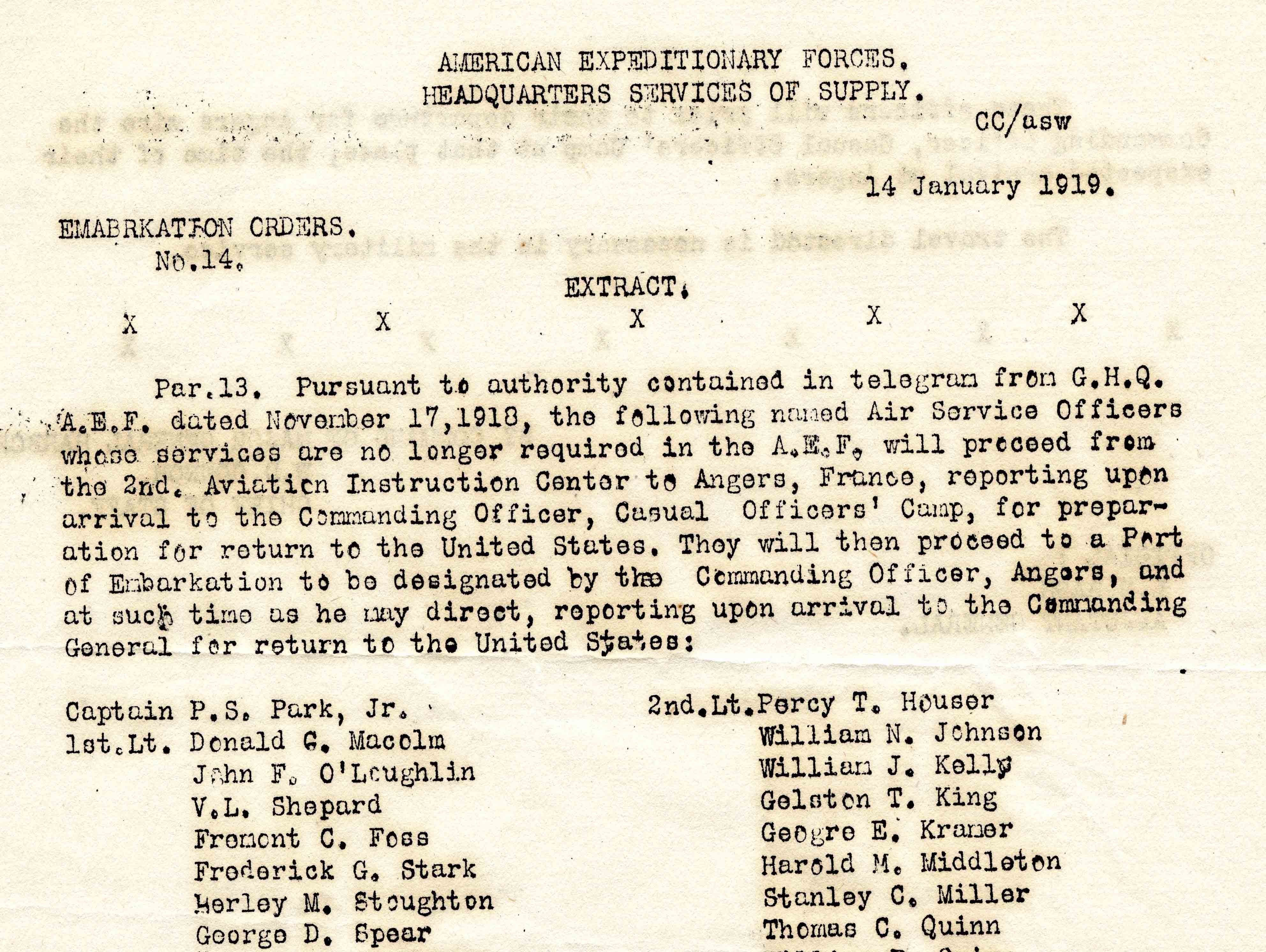
From Angers, they were ordered to Brest, where on February 2, 1919, they boarded the La France. They arrived in record time at New York on February 9, 1919.134
Stoughton returned to Burlington where, in 1920, he married Pauline Ardele Preston; the ceremony was conducted by John A. Hamilton, father of Lloyd Andrews Hamilton, who had died in combat during the war.135 Stoughton worked for a time for the Burroughs Adding Machine Company and then founded Stoughton Motor Company. Later he returned to newspaper work in New York, eventually becoming managing editor of the Essex County Republican in Keeseville, New York.136
mrsmcq August 11, 2026
Notes
(For complete bibliographic entries, please consult the list of works and web pages cited.)
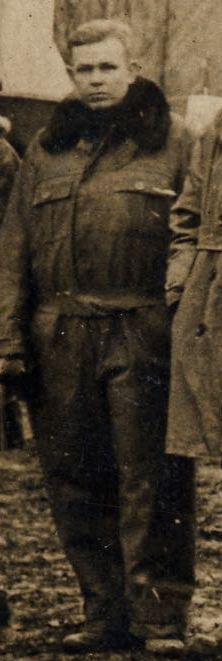
1 Stoughton’s place and date of birth are taken from Ancestry.com, U.S., World War I Draft Registration Cards, 1917–1918, record for Perley Melbourne Stoughton. His place and date of death are taken from “Perley M. Stoughton Former Editor of Essex County Republician [sic] Dies.” Photo is a detail from a photo of Stoughton in Paul James McWilliams’s album. Courtesy of Mike O’Neal.
2 On Stoughton genealogy, see Stiles, The History And Genealogies of Ancient Windsor, Connecticut, vol. 2, pp. 721–42, particularly pp. 737 (family 49), and 741 (family 69). NB: Stiles does not include Alansing Guy Stoughton among the children in family 69, but genealogy sites generally accept that A. G. Stoughton was a son of William. Further research would be welcome.
3 For information on the Stoughton family, see, in addition to Stiles’s work cited above, documents available at Ancestry.com.
4 “A. C. Stoughton.”
5 On the Patnods, see documents available at Ancestry.com. The name was perhaps anglicized from Patenaude or the like.
6 A folder in the Perley M. Stoughton Papers is labeled “Burlington Grammar School – report cards, 1906, 1907.” Stoughton’s application to the Signal Corps (in the Stoughton papers folder labeled “Military Documents 1917”) specifies his high school.
7 Ancestry.com, 1910 United States Federal Census, record for Perley M Stoughton; and see his draft registration, cited above.
8 See application in the Perley M. Stoughton Papers, folder labeled “Military Documents 1917.”
9 “P. M. Stoughton Leaves Newspaper Work in Answer to War Call.”
10 On William Stoughton, see Stiles, The History and Genealogies of Ancient Windsor, Connecticut, vol. 2, pp. 721–24.
11 On wireless, see Stoughton’s letter dated “Thursday night, June 19 [sic; sc.: 21], 1917. This and the other Stoughton letters cited are in the Perley M. Stoughton Papers. The letters are in separate folders for each month.
12 See Stoughton’s July 1917 letter headed “Saturday night 9:40 o’clock.” Stoughton often only provided the day of the week rather than the date in his letters home from Boston.
13 Letter of “Tuesday Morning” in the August 1917 folder of the Perley M. Stoughton Papers.
14 Nevertheless, his name appears in “Ground School Graduations [for August 18, 1917].”
15 Information in this paragraph is taken from letters in the August 1917 letters of the Perley M. Stoughton Papers. The quotation is from the letter in that folder headed “Tuesday night.”
16 See the entry for John A. Hamilton in H. A. Manning Co., Burlington and Winooski (Vermont) Directory 1918. And see Carl Stoughton’s letter to his mother of November 9, 1917, in which he refers to a conversation between the two mothers.
17 This is the “pocket diary” for 1917 in the Perley M. Stoughton Papers.
18 See Stoughton’s letter of “Friday morning” in August 1917 folder in the Perley M. Stoughton Papers in which he mentions visiting a fraternity house in Boston “where one of the lieutenants from the school here is living”; the lieutenant was almost certainly Deetjen. See Deetjen’s diary entries for August 8 and 31, 1917.
19 See Stoughton’s letter of October 6, 1917. I have not been able to identify the cleric, whose daughters Stoughton also mentions. Obvious candidates (William Sanday, Thomas Banks Strong, canon and dean respectively) with access to private Christ Church gardens were without children.
20 See Foss’s diary entries for October 6 and 7, 1917.
21 Stoughton’s letter of October 16, 1917.
22 Stoughton letter of October 25, 1917. The major was perhaps George Graham Adeley, second in command at the Oxford S.M.A.
23 Stoughton letter October 21, 1917.
24 Foss, diary entry for October 21, 1917.
25 Foss, diary entry for 22, 1917.
26 See note 20 to Chapter 2 of Springs, Letters From a War Bird.
27 Foss, diary entry for November 1, 1917.
28 Hooper, Somewhere in France, letter of [November] 4, 1917.
29 Foss, diary entry for November 2, 1917.
30 Ibid.
31 Foss, diary entry for November 3, 1917
32 See Stoughton’s pocket diary entry for this day (The Perley M. Stoughton Papers), and Foss’s diary entry.
33 Stoughton’s letter of November 15, 1917. The generous flight commander, according to Foss (November 4, 1917, diary entry), was an otherwise unidentified Captain Spence.
34 See Stoughton’s letter to his mother the next day for the identification of “Dearest Auntie” as his Aunt Nan.
35 See the entries of November 5 and 14, 1917, in Foss’s diary, and the entry for November 5, 1917, in Stoughton’s pocket diary. Foss misremembered the name of the operetta as “The Girl from the Mountains.”
36 See Ancestry.com, Canada, World War I CEF Personnel Files, 1914-1918, record for William Thomas Powell.
37 On the trip to London and Wiltby, see Stoughton’s letter of November 11, 1917, and his pocket diary entry for November 10, 1917.
38 Cf. Stoughton’s letter of November 19, 1917, which states that the last exam was on Saturday. Entries in Joseph Kirkbride Milnor’s diary for November 15 and 16, 1917, indicate that the last exams were on Thursday and Friday.
39 Foss, diary entry for November 17, 1917.
40 Stoughton, letter of November 15, 1917.
41 Stoughton, letter of December 2, 1917.
42 Stoughton, letter of December 2, 1917.
43 Stoughton, pocket diary entry for November 30, 1917.
44 Foss, diary entry for December 3, 1917.
45 Stoughton, letter of December 7, 1917.
46 Thomas, “Yorkshire’s Lions.”
47 Foss, diary entry for December 3, 1917; Stoughton, pocket diary entry for December 3, 1917. Stoughton’s letter of the same date implies he arrived December 2, 1917, but it is likely that the letter is misdated.
48 Stoughton, pocket diary, entry for December 5, 1917; Foss, diary entry for same day.
49 Stoughton’s letter of December 7, 1917.
49a Ancestry.com, Great Britain, Royal Aero Club Aviators’ Certificates, 1910-1950, record for John Overton Cone Orton.
50 The latter is also preserved in The Perley M. Stoughton Papers.
51 On Cook, see The National Archives (United Kingdom), Royal Air Force officers’ service records 1918–1919, record for William Wallace Cook.
52 See these pilots’ records in The National Archives (United Kingdom), Royal Air Force officers’ service records 1918–1919. On Hill, see Stoughton, letter of March 6, 1918, and Foss, diary entries for December 10 and 11, 1917.
53 Foss’s diary entries of December 17 and 18, 1917. See “Theatres and the Halls,” which indicates that the music was by Richard Cleveland. This was apparently the pen name adopted by Richard Cleveland Templeton Woolley, who was married to Captain Orton’s sister.
54 Stoughton’s letter of December 30, 1917.
55 From Stoughton’s letter of January 2, 1918, which he, having just received a December letter from his mother, has mistakenly dated December 2, 1918.
56 Foss, diary entry for December 31, 1917
57 Stoughton, letter of December [sic; sc. January] 2, 1918.
58 Ibid.
59 Ibid.
60 On Stoughton’s Helperby roommates, see his letters of February 2, and March 6, 1918; and see The National Archives (United Kingdom), Royal Air Force officers’ service records 1918–1919, records for Adrian Clifford de Fleury and for Sydney Hill.
61 Stoughton, letter of January 18 [1918]. See also Foss’s diary entry for January 12, 1918. Foss indicates that the ill officer was (the unmarried) Bourne, along with a batman. Stoughton refers to a married officer.
62 See Stoughton’s letter of January 28, 1918. The Helperby invitation may have come from the Utterson-Kelsos and the Boroughbridge one from the Daggetts; the vicar who asked him to lunch in Pilmoor is unidentified.
63 Foss, diary entry for January 26, 1918. The man was Thomas Reginald Hatton; see Stoughton’s letter of March 6, 1918, where he mentions “Tom Hatton,” and see The National Archives (United Kingdom), Royal Air Force officers’ service records 1918–1919, record for Thomas Reginald Hatton.
64 Stoughton, letter of February 2, 1918, to the otherwise unidentified Mr. Ladd.
65 Ancestry.com, 1939 England and Wales Register, record for Albert C Black, specifies address as Top Farm, Waddington. And see “Top Farm and Outbuildings.”
66 Stoughton, letter of March 9, 1918.
67 Stoughton, letter of January 28, 1918.
68 Foss diary entry for February 14, 1918.
69 See entry in Stoughton’s (loose-leaf) diary for this day. He apparently wrote of this minor crash in a letter to his mother’s sister, through which his mother came to learn of it. See Stoughton’s letter of July 11, 1918.
70 Stoughton, loose-leaf diary, entry for February 23, 1918.
71 Deetjen, diary entry for February 23, 1918.
72 Stoughton, letter of February 24, 1918.
73 Stoughton, letter of February 23, 1918.
74 Stoughton, letter of March 4, 1918.
75 Cf. Deetjen’s diary entry for March 5, 1918. The four were George Orrin Middleditch, Chester Albert Pudrith, Stahl (all at Waddington), and John Warren Leach (at Stamford).
76 Stoughton, loose-leaf diary, entry for March 6, 1918.
77 Foss, diary entry for March 7, 1918.
78 Stoughton, loose-leaf diary entry for March 7, 1918.
79 Foss, diary, March 7, 1918. I have not been able to identify “Uncle Charley.”
80 Stoughton, letter of March 6, 1918.
81 Stoughton, loose-leaf diary entry for April 4.
82 Stoughton, letter of April 12, 1918.
83 Ibid.
84 The account and quotations in this and following paragraphs about this trip are taken from Stoughton’s loose-leaf diary unless otherwise noted. Stoughton’s identifying the plane by number without the preceding letter is not unusual. The full serial number is supplied by Robertson, British Military Aircraft Serials 1878–1987.
85 Stoughton, letter of April 12, 1918.
86 Pitts is unidentified, unless he was Louis Campling Pitts who was apparently at Waddington at the same time as Stoughton; see The National Archives (United Kingdom), Royal Air Force officers’ service records 1918–1919, record for Louis Campling Pitts.
87 Quotations are from the entry for April 8, 1918, in Stoughton’s loose-leaf notebook diary.
88 Ibid.
89 Stoughton, letter of April 12, 1918, where he is careful use circumlocutions rather than city names.
90 See “Cramlington (Airfield) (Newcastle).” See also Davis, “Cramlington Aerodrome.” Davis notes that “The DH6 could, if flown solo, carry a small bomb load and the task of the new flights was to fly regular patrols along the North East War Channel with the primary aim of keeping enemy submarines submerged below periscope depth.”
91 See cablegrams 726-S (March 13, 1918), 955-R (March 21, 1918), 874-S (April 8, 1918), 1029-S (April 30, 1918), and 1303-R (May 13, 1918).
92 Stoughton, letter of April 28, 1918.
93 Stoughton, letter of May 3, 1918. NB: in this same letter Stoughton mentions not having gotten his April pay card signed “because my C.O. is in hospital.” Stahl had been made C.O. of Americans at Waddington in early March, but was injured in a crash on May 1, 1918; Vincent Paul Oatis took over Stahl’s duties not long afterwards.
94 See Foss’s R.F.C. Training Transfer Card and Stoughton’s letter of May 3, 1918.
95 Foss’s R.F.C. Training Transfer Card.
96 See Stoughton’s letters of May 24 and June 9, 1918. In the former, Stoughton states Orton “is about fifty miles away from here,” which is puzzling, as Retford is considerably closer to Waddington than that. On Orton, see The National Archives (United Kingdom), Royal Air Force officers’ service records 1918–1919, record for John Overton Cone Orton.
97 See Mrs. Gilbert’s letters to Stoughton, which are included in the folder of Stoughton’s letters from June 1918; and see Stoughton’s letters of July 1, 11, and 19, 1918.
98 Biddle, “Special Orders No. 116.”
99 Stoughton, letter of July 17, 1918.
100 Stoughton, letter dated July 11, 1918.
101 “City News” (September 4, 1918).
102 Thetford was an air base near Methwold where the two visited Ellen Elizabeth Melbourne, mother of a friend of Wright’s.
103 “City News” (October 15, 1918). I assume the name “Adrian” arose out of some kind of misreading, or perhaps confusion with Stoughton’s Helperby roommate (Adrian Clifford de Fleury); see, similarly, the letter written November 20, 1918, by Stoughton’s mother.
104 See Stoughton’s letter of September 17, 1918. See documents available at Ancestry.com indicating that Anna Irene and her first husband had divorced in 1914, freeing her to remarry.
105 See his letters of September 16, 17, and 19, 1918.
106 Stoughton, letter of October 4, 1918.
107 See the serial numbers of DH.9s in Foss’s pilot’s flying log book and the engines listed for them in the relevant list in Pentland’s Royal Flying Corps.
108 See Stoughton’s Septbember 1918 letters.
109 See the roster of officers on p. 87 of Hicks, “History of Operations of the 166th Aero Squadron.”
110 “The Squadron has an Eventful History.”
111 See “The Squadron has an Eventful History,” continuation, p. 3, which indicates a very early morning arrival.
112 Letter of September 30, 1918.
113 Sloan, Wings of Honor, p. 355.
114 Stoughton, letter to his mother, September 30, 1918.
115 Stoughton, letter of October 1, 1918.
116 See his letters of October 4 & 8 October.
117 Stoughton, letter of October 16, 1918.
118 Rath, “First Day Bombardment Group, Account of Operations,” pp. 129–30, and Hicks, “History of Operations of the 166th Aero Squadron” pp. 85 and 103.
119 Hicks, “History of Operations of the 166th Aero Squadron,” p. 90.
120 For their course, see the raid report on p. 103 of Hicks, “History of Operations of the 166th Aero Squadron.”
121 Stoughton, letter of October 20, 1918. There are discrepancies among the records in Gorrell and in other accounts of this raid, so that it cannot be said with certainty which or how many planes “went down.” But see “Pilots Bomb Plane Over Hun Position” for the account provided by Harry Alexander Schary. The account provided by, perhaps, George Raymond Cullman, in T-2003 [pseud.], “Pilots vs. the Sandbags” includes enough inaccuracies that its documentary value is open to question. For the identification of “Ray” as Cullman, see Chapmen, “Latecomers,” p. 75.
122 Letter of October 20, 1918. To his credit, Jenks went on to do good work as Devery’s observer.
123 Rath, “First Day Bombardment Group, Account of Operations,” p. 131; Hicks, “History of Operations of the 166th Aero Squadron,” p. 91.
124 The first two quotations are from p. 133 of Rath, “First Day Bombardment Group, Account of Operations”; the third is from Hicks, “History of Operations of the 166th Aero Squadron,” p. 85. I have not been able to discover who piloted the third downed plane, if, indeed, there was such—Rath’s and Hicks’s documents include some inaccuracies and discrepancies.
125 Rath, “First Day Bombardment Group, Account of Operations,” pp. 134–35; Hicks, “History of Operations of the 166th Aero Squadron,” p. 105.
126 Rath, “First Day Bombardment Group, Account of Operations,” pp. 136–38, where, on p. 136, for “96th,” read “166th.” Hicks, “History of Operations of the 166th Aero Squadron,” p. 107.
127 Rath, “First Day Bombardment Group, Account of Operations,” pp. 138–40; Hicks, “History of Operations of the 166th Aero Squadron,” pp. 108–09; quotations from p. 109.
128 Rath, “First Day Bombardment Group, Account of Operations,” pp. 141–42; Hicks, “History of Operations of the 166th Aero Squadron,” p. 110; Hooper, The First Team, 104–05.
129 Rath, “First Day Bombardment Group, Account of Operations,” pp. 145–47.
130 “Rest Chateau,” p. 86
131 Regarding Wright, Stoughton writes: “Poor Tommy is in hard luck . Got a letter from him yesterday & he says he is under arrest pending court martial charged with gross carelessness. He left a switch on when mechanics were turning his propeller preparatory to starting it & the thing [?] spun [?] breaking an arm of one of the mechanics . . .” Wright’s R.A.F. service record, which puts him at No. 1 A.S.D. (Marquise) at this time, has a notation dated November 7, 1918, stating that he was “severely censured by G.O.C.” See The National Archives (United Kingdom), Royal Air Force officers’ service records 1918–1919, record for Thomas Henry Wright.
132 “Stoughton Injured.” Balsinger was dropped from the rolls of the 166th on November 18, 1918, but not, apparently, due to any injuries, for he was reassigned two days later to the 96th Aero. See the roster on p. 87 of Hicks, “History of Operations of the 166th Aero Squadron” and the roster on p. 31 of 96th Aero Squadron.
133 Letter of December 31, 1918.
134 War Department, Office of the Quartermaster General, Army Transport Service, Lists of Incoming Passengers, 1917 – 1938, Passenger list for officers on S. S. La France.
135 Ancestry.com, Vermont, U.S., Marriage Records, 1909-2008, record for Perley M Stoughton.
136 “Perley M. Stoughton Former Editor of Essex County Republician [sic] Dies.”